
Hybrid Air Vehicles Plans Bigger Airlanders, Expands in the U.S.

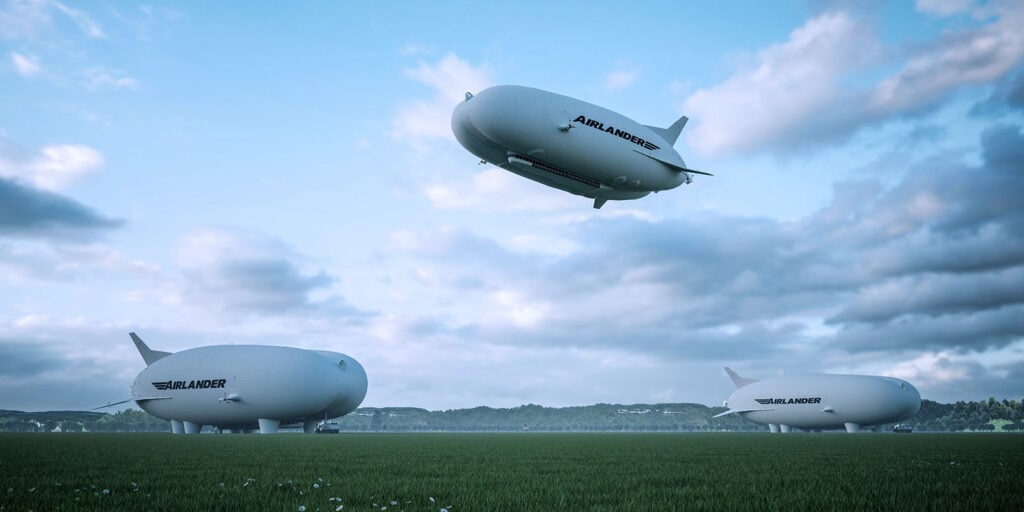
UK-based Hybrid Air Vehicles is moving on two fronts at once. The company behind the Airlander 10, the roughly 320-foot (98 m) hybrid aircraft the British public long ago nicknamed “The Flying Bum,” is laying the groundwork for substantially larger future models while also opening a U.S. subsidiary aimed at American defense, aerospace, and disaster response customers.
Taken together, the two threads sketch out HAV’s next decade: certify and produce the Airlander 10 in Doncaster, scale the airframe up to the Airlander 50 and possibly the Airlander 200 with substantially larger payload capacities, and build a transatlantic foothold to pursue the customers most likely to buy at that scale.
HAV designates each variant by its payload in tonnes (metric tons): the Airlander 10 (10 tonnes / about 11 short tons), the Airlander 50 (50 tonnes / about 55 short tons), and the Airlander 200 (200 tonnes / about 220 short tons).
A family of hybrids, not a single aircraft
The production Airlander 10 is HAV’s first commercial aircraft and the entry point of the lineup. It is a redesigned, slightly longer aircraft than the 302-foot (92 m) prototype that flew in 2016 and 2017, with refinements to the hull shape, propulsion, landing gear, and cabin. The platform is a hybrid airship in the literal technical sense: an aircraft that derives part of its lift from a helium-filled hull and part from aerodynamic forces, rather than from helium alone. HAV is pursuing type certification through the UK Civil Aviation Authority (CAA). The company says it will also seek certification or validation from other regulators, including the European Union Aviation Safety Agency (EASA) and the U.S. Federal Aviation Administration (FAA), as part of its global approval process. HAV says it worked with EASA and other buoyant-aircraft manufacturers to help develop the certification basis behind EASA’s 2022 special condition for gas airships, which it expects to inform the Airlander 10 certification basis. The company is targeting type certification in 2029.
The Airlander 10 is meant to be the smallest in the series. George Land, HAV’s executive sales director, told FLYING magazine that the company has long viewed a 50-tonne aircraft as the logical next step, and that the design scales beyond that without requiring a fundamental technology leap. The Airlander 50 is penciled in for the early 2030s, with HAV citing 2033 availability. According to the company, the variant will have a 98-foot (30 m) cabin large enough for six 20-foot ISO containers or 48 passengers, and a range of more than 1,367 mi. (2,200 km). An Airlander 200, with a 200-tonne payload, is on the table further out: that would surpass the maximum payload of the Airbus A380 and put HAV in territory currently served by ocean freight rather than aircraft.
The constraint, Land told FLYING magazine, is less about engineering than figuring out what role the larger aircraft will be built to serve.
How the Airlander actually flies
It’s worth a quick orientation for readers new to the Airlander platform. HAV does not classify it as a pure airship. Per Land’s description, helium provides roughly 60 percent of the aircraft’s lift (static lift, in airship terms: the buoyancy of a gas lighter than air). The rest comes from aerodynamic forces generated as the hull, which functions as a giant wing, moves through the air, and from vectored thrust, which is engine thrust directed through movable nozzles or vanes to push the aircraft in different directions, including up.
Inside the helium envelope are ballonets, air bladders that the pilot can inflate or deflate to manage envelope pressure and maintain shape as altitude and temperature change the helium’s volume. Forward and aft ballonets work as a trim system by shifting the center of buoyancy fore or aft.
The result, HAV says, is an aircraft that needs no runway. Land told FLYING that about 1,969 ft. (600 m) of flat ground (tarmac, grass, sand, or water) and a mooring mast (a vertical post that anchors the aircraft’s nose between flights) are enough. He cited an unloaded range of 4,603 mi. (7,408 km), dropping to 2,302 mi. (3,704 km) at full payload, and a top speed of 70 knots (81 mph, 130 km/h) indicated airspeed (IAS). The commercial cruise sweet spot is 50 knots (58 mph, 93 km/h), where two of the four engines can be shut down to reduce fuel burn.
One aircraft, three markets
HAV markets the Airlander 10 as a multi-role platform: passenger, cargo, and military missions out of the same airframe. The company has said it now holds more than £1.4 billion (about $1.9 billion) in civil reservation agreements, where customers have placed deposits pending final contracts.
The largest publicly disclosed civil reservation is from Spain’s Air Nostrum, which has reserved 20 aircraft for short-range, low-altitude passenger flights between Mediterranean islands. French operator Grands Espaces is eyeing the type for Arctic tourism. HAV’s pitch to that segment is essentially a slow, scenic, low-emission alternative to regional turboprops: spacious cabins (configurations run up to 130 passengers, with double bedrooms and dining areas for luxury layouts), an unpressurized cruise around 10,000 ft. (3,048 m), and routes under 230 mi. (370 km) where the slower speed is least problematic.
On the cargo and disaster relief side, logistics giant Kuehne+Nagel and the Oregon Department of Human Services’ Office of Resilience and Emergency Management both joined HAV’s Airlander Futures Network in March 2025, the former exploring freight use cases and the latter providing disaster-relief requirements. Land told FLYING that underslung loads (wind turbine blades, for example) and remote logistics are a particularly large opportunity.
HAV’s defense sector ambitions have moved more slowly into public view, but the company has spent the past few years building the relationships that will carry them forward, particularly with the establishment of a new U.S. subsidiary.
The U.S. subsidiary
On July 10, 2025, HAV announced the formation of HAV USA, a new subsidiary incorporated in the United States. The company said the move “supports growing interest from the US national security, aerospace, and disaster response sectors in Airlander.” A specific U.S. location was not disclosed.
Leading the subsidiary is John Schumacher, a former naval officer with 16 years at NASA who also serves as president of the International Academy of Astronautics. The choice signals where HAV USA expects to spend its time: federal customers, where credentials and access matter as much as the technical pitch.
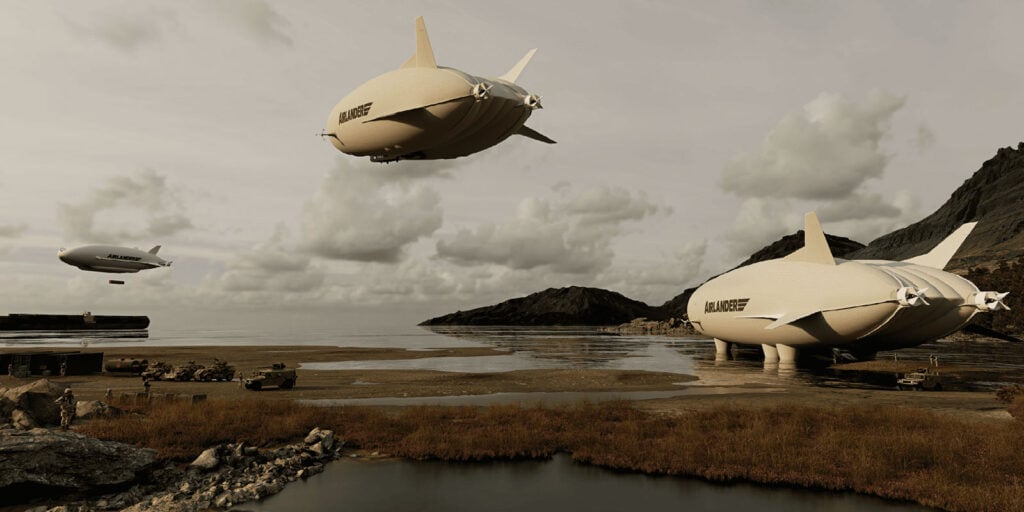
The U.S. push has a substantive backstory. In November 2023, HAV announced that the U.S. Department of Defense’s Operational Energy Office had signed a first-year contract, part of an up-to-three-year effort, to explore Airlander’s role in logistics and maritime operations. HAV is also working with BAE Systems on additional defense use cases under a memorandum of understanding announced in September 2023.
The proving ground
None of this is in service yet. HAV has no firm orders, only reservations. The full-scale Airlander 10 prototype completed seven flights before HAV retired it in 2019. Its development program included two high-profile setbacks: cockpit damage during its second test flight in 2016 and a 2017 ground incident in which the aircraft broke free from its mooring mast and deflated. Land has acknowledged that the platform has no specific mitigations for high-wind mooring conditions and that takeoff and landing operations are limited above 30 knots (35 mph, 56 km/h) wind.
The production Airlander 10 will be different in detail from the prototype, but the test campaign and certification work to come are substantial. FLYING reported HAV is planning a Doncaster factory targeting two dozen aircraft per year, although other sources have cited lower figures. The Doncaster factory, Airlander 50 development work, U.S. subsidiary, BAE Systems defense collaboration, and CAA-led certification path together make for an ambitious slate for a company that has not yet flown its production design.
What HAV has done in 2025 is line up the pieces. A bigger airframe is on the roadmap, the customer pipeline is broadening across passenger, cargo, military, and disaster response, and the U.S. market is now a direct point of contact rather than a long-distance sales call. The next test is converting reservations into firm orders and the prototype’s lessons into a certified production aircraft.
Sources and Further Reading:
- How Hybrid Air Vehicles Is Making the World’s Longest Aircraft Longer (FLYING)
- HAV Sets Up U.S. Subsidiary (European Security & Defence)
- Hybrid Air Vehicles Enters the U.S. Market (HAV announcement, July 10, 2025)
- Another Key Milestone on Airlander’s Certification Journey (HAV, March 2022)
- Airlander Certification Page (HAV)
- Airlander Technology Page (HAV)
- HAV Begins Airlander 10 Type Certification Programme (HAV announcement, February 2024)
- Global Logistics and Freight Industry Players Explore Use of Heavy-Lift Airlander (HAV announcement, March 2025)
- A Closer Look at the Updated Airlander 10 Design (HAV)
- Hybrid Air Vehicles Airlander 10 (Wikipedia)


Responses