
A Conversation with Dominic Etzold, Author of The Africa Ship

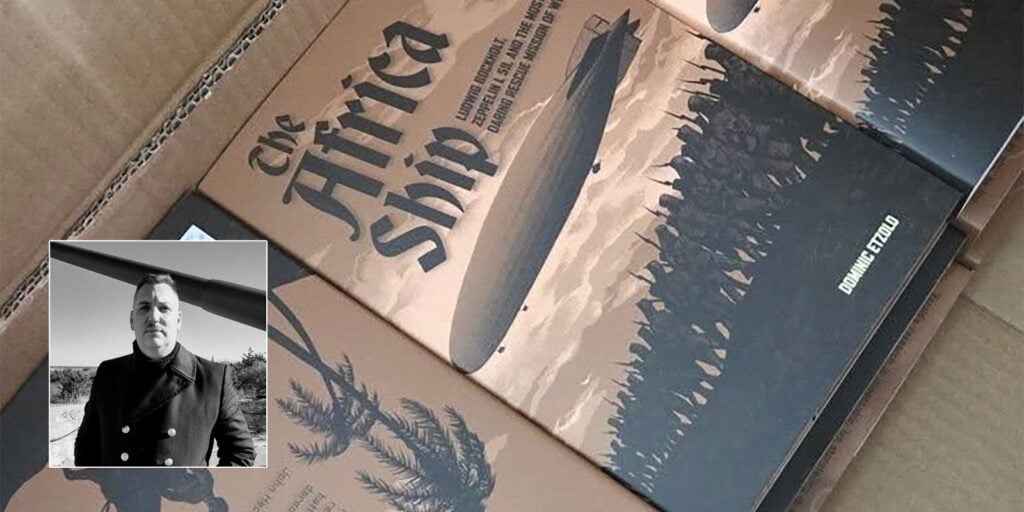
Dominic Etzold’s new book, The Africa Ship: Ludwig Bockholt, Zeppelin L 59, and the Most Daring Rescue Mission of WWI, takes the reader inside one of the most audacious and least-understood operations of the First World War, with a depth of original research few writers have brought to the subject. I sent him a list of questions, and his responses cover the politics behind the mission, the case for a captain history has misjudged, the myths he set out to correct, and much more. The full exchange follows, lightly edited for clarity. My questions are in bolded italics followed by Dominic’s answers.
Origins and the author’s path to the story
Your first book covered U-boats off North America in WWI. What pulled you from the depths of the Atlantic up to the skies over Africa for this second project?
When I first got into WWI history as a kid, I was initially drawn to the war in the air. U-boats and the imperial German navy came later ,and certainly stuck, but I never lost interest in the various aircraft and dirigibles that flew between 1914-1918. After completing my first book on German U-cruisers, and frankly being overwhelmed with submarine history, I decided to pivot a bit and focus on some of the stories I read about as a child, when history was still fresh and exciting. Of the various Zeppelin missions I had read about, L 59’s flight toward German East Africa stuck out as being unique and one that still had a lot of lingering, unanswered questions.
When did you first encounter the L59 story, and what was the moment you knew it deserved a full book rather than a chapter or article?
One of the books in my small personal library as a child was Douglas Robinson’s The Zeppelin in Combat. That was the first time I encountered L 57/59’s story. I had read that book from cover to cover in the 1990’s and then re-read it in college, but never really considered exploring anything beyond what Robinson actually wrote. When I re-read it again as an adult, and now with a book under my belt and a wealth of experience researching German archival material, I felt that there simply had to be some missing information that either hadn’t been found or perhaps was simply overlooked – it just didn’t make sense that there were so many variations of the stories about the mission being published. Certainly, there seemed to be a reliance on second-hand, and often English-language only, works in the more commercially popular books like African Kaiser. In the earliest stages of investigating L 59, I realized there was about 700 pages of primary sources that included telegrams, correspondence, war diaries, and reports all related to the China-Sache operation in the German Archives alone! With that much information available, sourced directly from the people involved in the mission, it was clear this had to be a book and not simply an article.
The L59 mission sits at an unusual crossroads: Imperial German naval aviation, the East African campaign, and Lettow-Vorbeck’s legend. Which of those threads grabbed you first, and how did the others fall into place?
I would say that Imperial German naval aviation appealed to me much more than the war on the ground in the colony – but you can’t tell one story without the other. I think what makes The Africa Ship different from other history books is that it evaluates both the war on the ground and in the air simultaneously and in great detail. When you read Afrika zu unsern Füssen, you’re presented only with the story of L 59 and even then, just a small part of it. When you read books like Edward Paice’s World War I: The African Front or Boell’s Die Operationen in Ostafrika you hear primarily about the battles of the Schutztruppe – with L 59 being mentioned only in passing (if at all). With The Africa Ship, I made use of varying primary sources from the Naval Airship Division, the Reichskolonialamt, the Schutztruppe, and even the British colonial forces to give a complete picture of why the mission was planned in the first place and how it evolved with the changes on the ground.
Schiffer Military History has now published two of your books. What does that working relationship look like, and how did this project come together with them?
When I shopped my first book, Reaping the Whirlwind, I only sent the manuscript to four publishers that I felt put out high-quality and well-researched books where the focus was on history as opposed to simply telling a good yarn. Three of the four were interested, but the director of Schiffer’s military imprint called me personally and spoke about the work at length. This impressed me and I came to see after signing with them that Schiffer Publishing has more of a family atmosphere and promotes a personal relationship with its authors. I’ve always had the final say in what went to print and conversations with the team throughout the publishing process were always easy.
Research and sources
Researching Kaiserliche Marine operations while based in New Jersey can’t be easy. Walk us through what your archival hunt looked like for this book.
I don’t think many people realize that the British did us a great service by capturing and photographing the German naval archives (dating back to 1850) located at Schloss Tambach during World War II. Because they shared their haul with the US, you don’t have to go to Germany to view the records of the Naval Airship Division or the RMA – they can be viewed on microfilm at College Park, MD or digitalized at a cost. This made a significant portion of the primary sources used in The Africa Ship available locally. Of course I wound up hunting down rare books and photos seemingly only available in Europe and having them shipped over which took time, money, and effort, but some of the biggest payoffs were actually obtained for free. I spent months trying to find copies of the Wilnaer Zeitung – the newspaper published in occupied Lithuania that Max Zupitza read, leading him to suggest the mission to the RKA – and eventually found an online Polish library that scanned their collection of this newspaper. It took days going through all of that to actually locate the article he read, but I did. I haven’t seen that actual article cited in any other work about L 59, rather it is just mentioned anecdotally or second-hand.
Were there any German-language primary sources, diaries, logbooks, or official reports, that proved especially valuable, or that you felt had been underused by previous English-language accounts?
Yes, quite a few. With regard to the ground war in German East Africa, Karl Ernst Göring’s memoir and Boell’s Die Operationen in Ostafrika proved to be excellent accounts of the experiences of the Schutztruppe and were great ways to check or counter the very general, and sometimes boastful, claims made by von Lettow-Vorbeck in his memoirs. I’ve only seen Boell’s work cited in academic works and Göring’s almost never. Concerning German language sources about L 57 and L 59, there’s of course Afrika zu unsern Füssen and the file for China-Sache within the German archives. Although technically not in German, Alastair Reid did an excellent job of compiling and translating the Marine-Luftschiffer-Kameradschaft newsletters, which he then self-published. These provided numerous personal stories and anecdotes that you simply can’t find anywhere else. Finally, the war diary of SM UB-53 provided valuable insight to L 59’s final hours and contrasted the oft-repeated version provided by the U-boat’s watch officer, Oberleutnant Wolfram, in reaction to the Hindenburg’s crash in 1937.
Douglas Robinson and others have written about L59 before. What did you set out to do differently, and what new material were you able to bring to the surface?
It is true that Robinson, and others, have covered L 59 already, but as mentioned earlier, they do so only cursory. I don’t think any other book currently exists that covers the entire story of L 59, from inception through destruction, as in-detail as The Africa Ship. While other books mention ambiguous messages allegedly sent by the Schutztruppe or fake radio signals sent by the British, this book actually provides the reader with exactly what the RMA received and what was transmitted to and received by the airship. It also covers the much less publicized story of L 59 after the mission to German East Africa, including the politics of converting the airship and continuing to operate from Yambol against long distance targets. Nothing is left up to speculation and there are extensive citations for every fact quoted.
Did anything you found in the archives genuinely surprise you, something that changed how you understood the mission or the people involved?
It seems silly, but something rather surprising that flies in the face of every image and model produced of L 59 was the flags being painted under its bow. Everything I have seen depicts an Austrian flag and an Turkish flag; however, Bockholt very clearly states that giant-sized “German” and Turkish flags were painted in the archives (see image below).
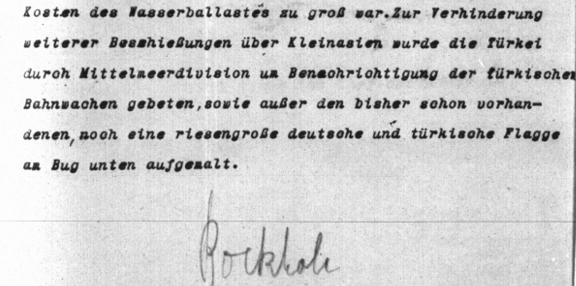
On a more serious note, the relationship between Bockholt and Hans Humann (the naval attaché in Turkey) that came to light both in the planning phase of China-Sache and after L 59 had been converted to a bomber was entirely unexpected. It became quite apparent that the Mediterranean Division had ties to Bockholt and wanted to utilize L 59 in their theater instead of sending it to the North Sea – essentially going over the head of Peter Strasser. Without giving anything away, the politics going on in the background were absolutely fascinating before and after the African mission.
Were there dead ends, sources you wanted access to but couldn’t get, or questions you wish you could still answer?
I really wanted to explore more of Ludwig Bockholt’s personal story both before and during the war. He was an interesting personality and one that I think is unjustly treated by historians. Unfortunately, he left little behind in the way of correspondence or personal records. I had seen that there was a somewhat recent article written about him by an academic in Dusseldorf (his hometown) that allegedly went into the detail I was looking for, but I could not procure it anywhere and contacting the author directly went nowhere. If anyone can find it, I would still love to read it!
Ludwig Bockholt, the man
Bockholt is a name even many airship enthusiasts know only in outline. Who was he as a person, beyond the captain’s hat?
As mentioned in my response to the previous question, I wish I could provide more on Bockholt than I have in The Africa Ship. What I can say about him from reading his various telegrams, interviews, reports, and war diaries is that he was very clever, ambitious, and strategically-minded. Although depicted by others as being an opportunist with connections higher up or even a stoic soldier who blindly followed orders, none of this held up to scrutiny. For one, he was denied a medal that should have been an automatic reward for anyone else and certainly was not beyond the reach of criticism from Strasser or other superiors. Going against being a cold-automaton, he had a sense of humor (joking about not being able to go to Naples on a honeymoon if he got married since he bombed it) and showed considerable concern for the well-being of his crew, repeatedly going to bat for them for better provisions and their overall well-being.
He volunteered for what was essentially a one-way mission. What in his background or temperament do you think led him to that decision?
I don’t think there was anyone in the Naval Airship Division that would have said no to volunteering for this mission. Certainly, von Buttlar-Brandenfels and his crew were unanimously set to go when Strasser mentioned it to them. Similarly, when L 57 was lost, Strasser mentioned replacing Bockholt and his crew with Kplt. Ehrlich and his crew who were also standing by and ready. It was a daring and prestigious mission that any airship-man would have been eager to take. That being said, Bockholt raised some pertinent concerns about the mission before fully committing, illustrating what I think is his intelligence and strategic mindset. Perhaps helping him make his decision was that he was unmarried and had no family to leave behind. When listing his next of kin prior to the mission, he only named his mother back in Dusseldorf.
How was Bockholt regarded by his peers in the Naval Airship Division, and by his superiors like Peter Strasser?
One of the most common stories you hear about Bockholt is that he was disliked by his peers who regarded him as a selfish careerist with connections in the naval leadership. The same sources generally claim that he had an antagonistic relationship with Peter Strasser and that strings were pulled to land Bockholt as the commander of the Africa mission, but then in the same breath claiming that Strasser chose him intentionally because he was “expendable.” Photographic evidence certainly paints a different picture, as do the recollections of some of these peers. Von Buttlar claimed that there “was no man better fitted [than Bockholt] for such an undertaking [as the China Matter]” with Lehmann also offering praise. As far as experience, Bockholt had already flown 35 missions, including one where he captured the Royal and another where he was sent to find and escort an airship carrying Peter Strasser back to base. Bockholt was actually about to be awarded the command of a Zeppelin capable of raiding England when he was selected to take command of L 59. An actual case of political favoritism, such as when Strasser allowed von Lossnitzer to lead a raid on England with himself on board, resulted in the FdL being killed.
Bockholt’s relationship with FdL Strasser was another matter. While seemingly friendly and supportive early on, this soured when Bockholt began proposing his own ideas for using L 59 after the flight toward East Africa. Bockholt had a vision that went against Strasser’s wish for another North Sea bomber and was ultimately supported by Strasser’s superiors (with good reason). I think Strasser saw Bockholt as trying to become his own private FdL on the Southern Front, instead of fighting on the same team against common enemies.
Was there anything about him that struck you as contradictory or unexpected as you got to know him through the records?
Bockholt remains fairly consistent in his thoughts and actions when reviewing the records, there were little surprises with him. On the other hand, we see an entirely different side of Strasser in the archives, particularly when dealing with Bockholt later on. While the greatest advocate for Zeppelin combat missions and pushing the airships to their limits, Strasser took issue with Bockholt wanting to continue making long-distance flights with L 59 to raid remote targets across the Mediterranean. Bockholt’s logic, presented very clearly in his reports, actually sounded a lot like Strasser’s rationale for raiding England; however, Strasser wanted none of it and often became emotional and contradictory in his arguments. You almost sensed that Strasser felt satisfaction when Bockholt ultimately failed in his endeavor when L 59 was lost.
The mission itself
For readers new to the story: in plain terms, what was the German command actually trying to accomplish with the L59 flight to East Africa?
Essentially the idea was for L 59 to delivery much needed ammunition, provisions, medication, and morale boosters such as medals to the Schutztruppe. While the supplies were scant compared to what was actually required by von Lettow’s forces, the mission would prove that the Fatherland did not forget its colonial forces. Additionally, such a feat would be sign of German engineering greatness and perceived military strength that would awe the world and the indigenous East Africans that were already realizing the British had the upper hand.
The plan called for L59 to be cannibalized for supplies on arrival, with the crew joining Lettow-Vorbeck’s forces on the ground. How realistic was that scenario, and did anyone involved seriously believe it would work?
The scenario was definitely thought to work and was thought out in detail. The gas bags could be converted into waterproof clothing, sleeping bags, and rain jackets worn by the Schutztruppe, the airship’s walkways were made of leather that could be cut into soles for boots, and the canvas “outer shell” could be cut up and fabricated into tents, clothing, and bandages. The actual duralumin skeleton of the airship could be cut into stretchers or utilized for the creation of a wireless antenna while the motors could serve as generators. Unfortunately, the crew would be additional heads to feed for an already starving army.
How did the L59 itself, the airship, get selected for this mission? Were there special modifications made? What made a Q-class Zeppelin the right (or only) tool for the job?
To be specific, an R-class Zeppelin – army Zeppelin LZ 120 – was what proved the concept of being aloft for 101 hours (and potentially many more). It had been estimated that 100 hours would be required to reach German East Africa and Lehmann’s record-breaking flight showed that existing airships were up to the task. The R-class had already been superseded by larger airships such as L 54, which was originally going to be commanded by Bockholt but was instead given to von Buttlar-Brandenfels and it was these later types that would form the basis for L 57/59 – what are now known as the W-class Zeppelins. What separated L 57/59 from the U and V-class Zeppelins was that they were extended by 2 frame rings (increasing the length and gas capacity) and there were no bomb-bays or machine gun platforms installed. They were long-range cargo airships and, as was determined later, had a range that could have carried them from Berlin to potentially as far as San Francisco.
Talk us through the flight itself. What were the conditions like for the crew over thousands of miles of hostile territory?
The condition of the crew was pretty terrible, but not due to being over enemy territory. Incredibly, the only time L 59 was actually fired upon was by Ottoman forces. What made the trip difficult for the crew was the constant altitude fluctuations caused by the weather and heat radiating off the African landscape along with the heat itself and the intense sunlight. Many of the crewmen became “airsick” and were so exhausted by the end of the flight that many collapsed upon reaching solid ground.
The famous recall signal that turned L59 back: there’s been historical debate about whether it was genuine, a British deception, or something else. Where did your research land on that question?
Although it’s not nearly as exciting as the mythology surrounding the flight, there was no British deception or even a desperate call from Lettow-Vorbeck that managed to reach Germany. Instead, the RMA and RKA had been relying on intercepted British transmissions for their news about the colony. In this case, they learned from British reports that von Lettow had fled to Portuguese Mozambique and thus there was no longer a landing site in German East Africa. This was not a British ruse, but instead reflected actual ground conditions.
If the recall hadn’t come, what do you think would have actually happened when L59 reached East Africa?
Had L 59 actually reached German East Africa and landed, it would almost certainly have been damaged or destroyed upon landing – even if the Schutztruppe was still there – due to the lack of a properly trained and manned landing crew. It could also have potentially been shot down by British forces who were utilizing aircraft within German East Africa to harass von Lettow’s forces. With no means of defending itself, L 59 was a sitting duck.
The bigger picture
The L59 flight set distance and endurance records that stood for years. How should we think about its place in aviation history, separate from the military outcome?
Long-distance aerial travel was still in its infancy when L 59 made its record-breaking flight and much was learned about conditions over tropical areas, the temperature inversions at altitude, and how the rapid heating of the gas bags during the day and the subsequent extreme cooling at night affected the airship’s hydrogen. Hugo Eckener had learned a lot from L 59’s voyage which helped him prepare for the various climates he would experience when he captained the Graf Zeppelin across the world and likewise helped Luftschiffbau Zeppelin with their trans-Atlantic routes.
What does this mission tell us about how Imperial Germany viewed the strategic potential of airships in 1917, especially as the bombing campaign over England was running into trouble?
Strasser, even in 1917, continued to press for attacks on England and wanted L 59 converted for that purpose upon returning from the aborted Africa mission. He and Bockholt differed, however, in where the bombing campaign should take place. Strasser wanted L 59 in the North Sea and potentially used for raids against England, while Bockholt wanted to focus on long-distance raids on far off targets in North Africa and Italy for the purpose of tying down resources away from the Western Front. Really, at this point in the war the only thing Zeppelins were suited to do was their typical long-distance reconnaissance duties and assisting with minesweeping, but there was a point in forcing the Allies to dedicate resources in the defense of cities and away from German ground forces.
Lettow-Vorbeck looms large over the East Africa campaign. How much did he know about the rescue attempt, and what was his reaction to learning of it?
Neither he nor Governor Schnee knew about the rescue attempt and when they were informed about it after the war didn’t believe that it could possibly have been true.
Are there parallels you see between the L59 mission and other audacious, long-shot resupply operations in military history?
I don’t think anything then or since has come close to what was being attempted by L 59 during WWI. I suppose the Berlin airlift was a similar concept, but did not have nearly the same distance to cover or the risks involved. The China Matter was such an ambitious operation for the time that a modern day equivalent would have to be something like a mission to rescue astronauts in a space station. It was that advanced and pioneering for its time.
L59’s final fate
L59 didn’t survive the war. Without giving away too much for readers who’ll buy the book, how do you weigh the different theories about her loss over the Mediterranean?
Of the three main theories I mentioned in the book, all are plausible, but some more than others. I go into detail about why and how (or how not), but the theory I landed on was well documented in complaints made by Bockholt and other airship commanders prior to L 59’s final mission and thus seems the most logical – particularly when considering the eyewitness report about the airship’s destruction.
Bockholt and his entire crew died with the ship. Were you able to learn much about who those men were as individuals?
We learn a lot about them through the writings of other men that knew them, such as Goebel and Foerster, the crewmembers who weren’t on the final mission such as Ernst Fegert, and even the list of the crew’s next of kin. I tried to include as much of that information in the book, but it was tough due to a lack of written records from the period.
Craft and storytelling
You’re writing about events from over a century ago, with most key figures long gone. How do you bring a story like this to life without straying into speculation?
This is a history book and not a novel, so everything that is featured in it, including dialogue, has a basis in fact that is properly cited. This is achieved through the use of memoirs, eyewitnesses, and the archival material. Being that the German archives contain every single telegram, interview, and report related to the mission, there was no shortage of viewpoints to pick from. I firmly believe that fact is much more interesting than fiction and this certainly proved to be the case while researching L 59.
The book includes 50 color and black-and-white photographs. Were there any images you were especially excited to include, or ones you wish you could have found?
I was excited to include an image of the Red Cross stamp created to raise funds for the victims of L 59’s raid on Naples that I own – that was an interesting piece to pick up and share. It was also great getting the permission to use photos from Friedrich Engelke’s personal album. These show images of the crew that haven’t ever been published in print before. I don’t think there were any images I wish I could have found, but rather there were a lot of images I wanted to use but couldn’t due to grey areas with copyrights. I have reproduction images of Bockholt and his crew in L 23’s control car which are fantastic, as well as a reproduction of the Maybach ad depicting L 59’s flight, but without definitive permission to use the images or proof that they are in the public domain, I simply couldn’t send them to the publisher.
What’s a detail or anecdote in the book that didn’t fit the main narrative but you couldn’t bear to leave out?
I don’t think there is any detail that doesn’t fit the narrative. This is such a niche topic and much of the information presented will likely be new to the reader. With the exception of debunking the various myths, I don’t think there will be anything scandalous to read about.
For the airship community
Airship history can sometimes feel like a club that lives in the shadow of the Hindenburg. What do you hope airship enthusiasts in particular take away from this book?
I hope airship enthusiasts can appreciate just how crazy the thought of L 59’s mission was at the time. In the modern age of quick and easy international travel, or even when considering the frequency of cross-Atlantic airship travel in the postwar years, it’s difficult to put oneself in the shoes of these early pioneers that had to learn about varying weather and altitude conditions in situ.
Are there other obscure airship stories from WWI that you think deserve the same treatment L59 just got from you?
L 16 flew a mini-relief mission to the isle of Juist in February of 1917 when ice prevented sea access to the island. I’m not sure one could write an entire book about that, but I think the subject would be worth exploring for an article.
Can you tell us where your research is taking you next, and whether airships might feature again?
Currently I’m in the process of researching another book about WW1 U-boats, but I’m certainly not done with airships yet. I have some ideas about another book on Zeppelins, but we’ll see what direction I end up going in if/when the next book is completed.
Closing thoughts
What’s the one fact about L59 or the mission that, when you share it at a dinner party, makes people say “wait, that really happened?”
Just the thought of a Zeppelin attempting to fly to Africa is enough to awe non-airship folk. They’re incredulous that such a feat could have even been possible in 1917.
If you could sit down for an hour with one person involved in the L59 story, Bockholt, Strasser, Lettow-Vorbeck, or one of the crew, who would it be, and what’s your first question?
That’s a really tough question. I’d probably pick Bockholt and ask about his decision to return to Bulgaria according to his orders instead of listening to the appeals of his crew and pressing on to German East Africa. That must have been a terrible decision to have the final word on and I really wonder what was going through his mind at the time.
Vintage motorcycles, militaria, archival research. Is there a through-line that connects what draws you to these things?
History is the common denominator. I’m obsessed with the past and can’t see any better way to connect with it than physically touching it. While I can read about L 33, I actually have a piece of that airship’s frame which I can hold and let my imagination go to work. When I fire my Kar.98AZ, I think of who may have held the same rifle in the Great War and under what circumstances. When I pore through war diaries and log books, I’m often touching the same paper that the people I’ve been reading about have actually put their signature on. To me, there’s nothing more exciting in life than this.



Responses