
Flying Whales Announces Major Milestones Met on New Airship Design

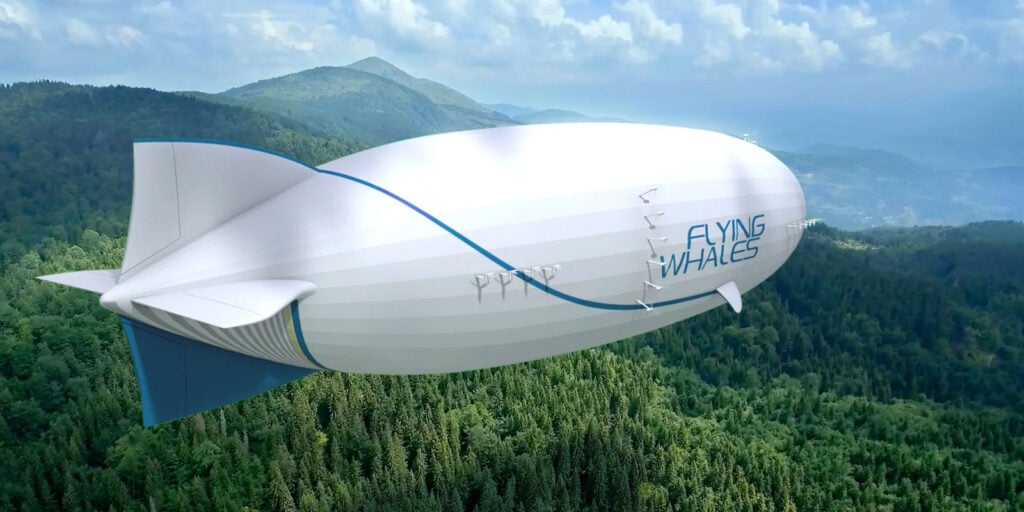
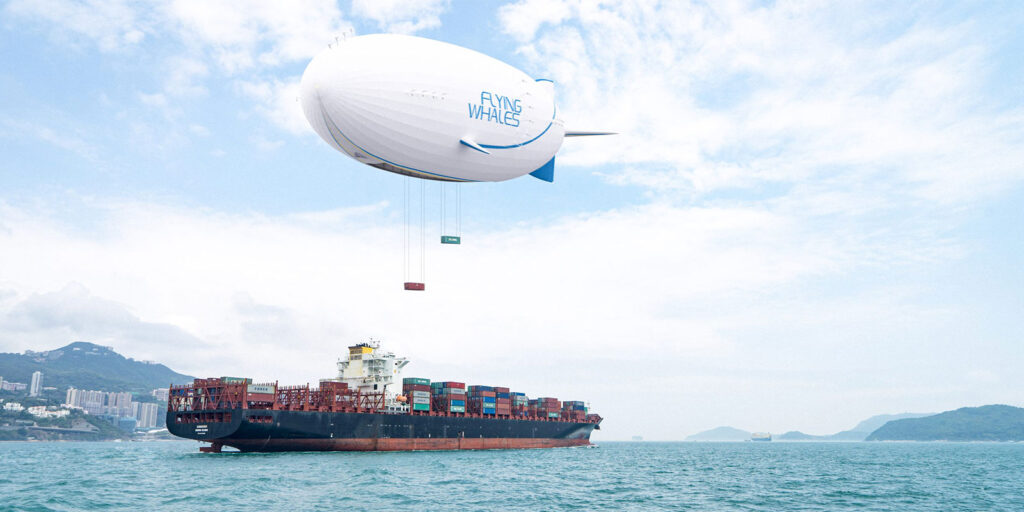
A France-based company is on track for a highly anticipated first flight of its “flying crane” airship–pushing to become the world’s first lighter-than-air craft capable of hovering payload transfers with up to 60 tons of cargo.
Designing an entirely new aircraft from the ground up is no small undertaking. In the case of the Flying Whales company, it has taken nearly 15 years to develop the aircraft–but the long wait to begin construction is almost over.
Prototype assembly of the LCA60T is scheduled to begin in 2027. As that milestone approaches, Flying Whales has begun locking in the suppliers, technology, and workforce needed to support production. Over the past year, three important milestones have been met: the group has taken delivery of its first power transmission prototype from the Safran Aviation Group, locked in a multi-partner composites supply chain to build the airship’s structural skeleton, and announced the location and development of an industry-specific training academy.
Building the LCA60T Airship – An Industry First
Flying Whales is not simply designing a lighter-than-air aircraft. The scope of the project is unprecedented, primarily because the company is constructing what could become the world’s first certified heavy-lift airship capable of hovering cargo exchange. The LCA60T name is an acronym, standing for Large Capacity Airship 60 Tons, and it is the 60-ton payload and the way it is designed to move cargo that makes it so unique.
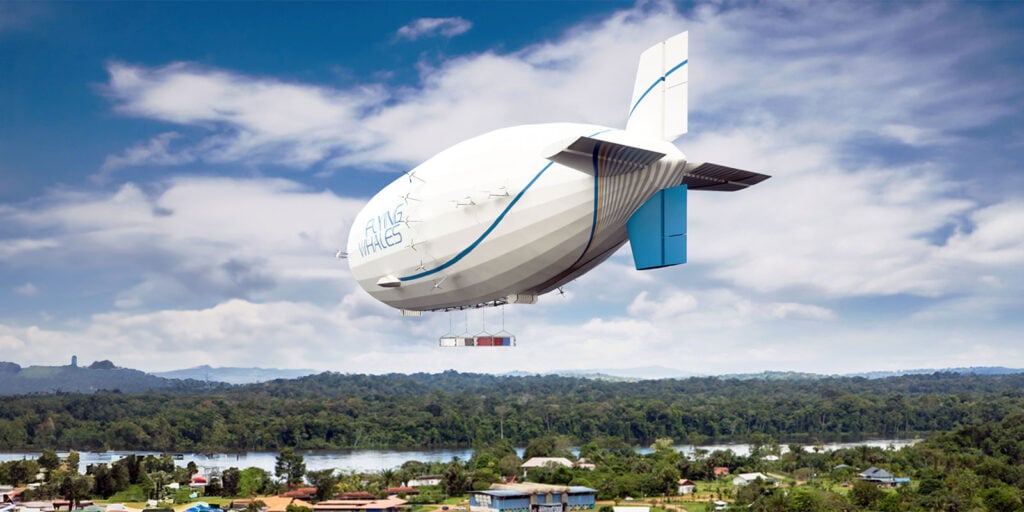
Dirigibles and blimps have performed hover-based cargo handling before, but never on this scale. Flying Whales boasts that the airships will be able to load and unload the 60-ton cargo loads while hovering, with no need for a runway or even a clearing big enough to set down in. That makes the airship appealing to forestry operators, infrastructure builders, and humanitarian aid for locations where roads do not exist—or would be prohibitively expensive to build.
Proposals for heavy-lift airships have envisioned off-airport operations before, but none has entered commercial service with the LCA60T’s advertised combination of 60-ton payload, hover loading, and infrastructure-free cargo exchange. The impressive cargo potential of the 656 ft (200 m) airship comes inherently from its design. Rather than relying on gas pressure to maintain shape, the LCA60T will be a fully rigid airship reinforced and supported by an internal structure that will support large cargo and crane mechanisms.
Safran Delivers Prototype Transmission
In July of 2025, Flying Whales crossed a major hurdle when Safran Transmission Systems handed over the first prototype of the power transmission system that will help drive the LCA60T’s initial propulsion configuration. The Safran contract was signed in 2023 and covers the development and supply of power transmission systems for the four turbogenerators on each airship.
The LCA60T uses a hybrid turboelectric architecture. The turbogenerators (gas turbines coupled to electrical generators) produce power that gets distributed to electric motors driving the propellers. The transmission system from Safran is designed to bridge the mechanical link between turbine and generator, a configuration different from the geared turbofans Safran is best known for. The company has noted publicly that this is the first time it has built power transmissions for this specific style of propulsion.
Safran’s involvement is not new to the project. Safran Electrical & Power’s affiliation started in 2021 with an agreement to supply the airship’s electrical generation, distribution, and conversion systems, covering the non-propulsive networks that power everything aboard the aircraft.
The transmission contract extends that footprint into the propulsive side. For a startup trying to certify a brand new aircraft of this scale, having one of Europe’s biggest aerospace suppliers carrying multiple workstreams is a meaningful credibility signal, even before the first flight.
Multi-partner Composites Pipeline Established for the Structural Skeleton
Another major milestone has been reached for Flying Whales in the area of logistics and supply. The company has been steadily building out the composite supply chain for the LCA60T’s rigid structure, and the arrangement of suppliers has been mostly solidified over the past year. Three industrial partners now form the core of that pipeline:
- Hexcel: A composites manufacturer with headquarters in the U.S.
- Exel Composites: Finnish suppliers of pull-wound and composite tubes
- DUQUEINE Group: A French company with strong ties in the avionics industry
The formalized contracts between the three companies happened in 2024, with an R&D and prototyping partnership between Hexcel and Exel. Then, in 2025, Hexcel announced that it had been selected to supply a broad range of composite materials for the LCA60T, including its HexTow IMA carbon fiber.
Most recently, a JEC World 2026 Innovation Awards announcement spelled out the division of labor: Hexcel supplies the rapid-cure advanced fiber materials, Exel converts them into pull-wound tubes that form the airship’s backbone, and France’s DUQUEINE Group uses robotic layup, automated winding, and prepreg overmolding to turn those tubes and additional composite processes into 23 ft (7 m) structural beams.
Creating the Ultra-Light Carbon Fiber Structural Frame
The concept phase for the LCA60T began in 2012, and while it may seem like a long developmental period, it’s not unprecedented for an innovative, certified aircraft of this scope. The recent hurdles that the company has crossed pave the way for what is arguably the single most important part of the airship—the rigid framework.
Unlike a blimp or semi-rigid airship, where all or part of the shape is maintained through gas pressure, Flying Whales’ rigid airship design requires a complete structural frame. That rigid framework must be strong enough to carry the aerodynamic and structural loads generated by the aircraft, including the substantial loads imposed by suspended cargo, all while staying light enough for the helium to maintain the airships’ lighter-than-air characteristics. Carbon-fiber composites are a logical solution, with high tensile strength and stiffness coming at a fraction of the density of aluminum.
Flying Whales decided that the use of pultrusion (the continuous process of pulling fiber and resin through a heated die to produce constant-cross-section tubes) was well suited to making the large quantities of structural components the LCA60T’s frame requires. Similarly, pull-winding is a related technique that adds wound reinforcement plies during the same continuous process, allowing additional strength to be built into the tubes where the structural loads demand it.
With roughly 47 mi (75 km) of tubing per airship and three final assembly lines planned worldwide, there were considerable hurdles in ensuring the supply chain would meet the scale.
Next Step – Creating a New Workforce
Flying Whales isn’t just making advancements with design and construction, either. The company’s third development in 2026 is arguably the most intriguing—simply because it concerns people rather than parts. An essential aspect of the business plan involves having trained, skilled pilots and crew; not a simple hiring challenge for a venture whose closest analog, Zeppelin transport, has been dormant for almost 90 years.
While helicopter long-line pilots and rigging crews working in sectors such as power-line construction and logging have similar skill sets, airship handling characteristics are different enough that Flying Whales deemed a dedicated training program would be required. Piloting a 656 ft (200 m) rigid airship at a hover while exchanging external sling loads is a task rarely, if ever performed, and Flying Whales predicts that the support crew will be essential to overall success.
Building a Dedicated School for Airship Professions
After two years of considering locations for a training facility, Flying Whales has settled on Agen La Garenne Airport in southwest France. Since then, the company has now launched the Flying Whales Academy, set to open in the coming months. The one-of-a-kind academy is being pitched as an industry first: a training center for pilots, mechanics, load operators, aerial crane operators, and riggers.
The specific tasks the LCA60T will demand are skills the company describes as not existing anywhere else in industry; at least, not in the format Flying Whales requires. Creation of a school dedicated to vessel-specific training is deemed a key part of establishing credibility.
Planning is On Track
When Flying Whales and Safran first announced their electrical-systems partnership in 2021, the hope was to establish a first flight by the end of 2024, with entry into service in 2026. Since then, the company’s FAQ area sets out a revised schedule:
- Local recruitment: Beginning in early 2026
- Assembly of the first airship: Early 2027
- First flight: Expected in mid/end 2027
- Certification of Ground and Flight: Tests leading into commercial operations for 2029.
These three milestones may seem unglamorous to some, but they are the critical logistical moves that Flying Whales need to make in order to achieve the goal of a flying prototype. The LCA60T’s new-concept electric propulsion and novel cargo-handling system are anticipated to require extensive engineering, testing, and certification before flight. Having a power transmission prototype on a test stand may not be as photogenic as a successfully hovering 656 ft (200 m) aircraft, but it is an important first step.
The company has also given some shape and timelines to the workforce anticipated at its main industrial site. The manufacturing plant in Laruscade, France, is expected to directly support around 300 jobs, with 200 Flying Whales employees and 100 subcontractors. Another 300 indirect jobs are forecasted within the greater ecosystem.
Sources and Further Reading:
- Safran: Safran onboard Flying Whales’ LCA60T airship! (July 2025)
- Aerocontact: Safran Equips Flying Whales’ Giant Airship with Its Innovative Transmission Systems
- Safran press release: Safran signs deal with FLYING WHALES to equip its LCA60T airship with electrical systems (2021)
- Hexcel: Flying Whales selects Hexcel for the supply of composites materials for its LCA60T airship
- Exel Composites: Exel Composites signs contract with FLYING WHALES for delivery of pull-wound composite tubes for the world’s largest airship
- Flying Whales: FLYING WHALES confies the manufacture of the LCA60T structure to Exel Composites
- JEC Composites: JEC Innovation Awards 2026 finalists
- Project Cargo Journal: Flying Whales opens doors to ‘rare’ cargo airship careers
- Flying Whales FAQ (program schedule, workforce, sites)

Responses