
Sceye’s Solar-Powered “SE2” Logs 12 Days and 6,400 Miles in the Stratosphere

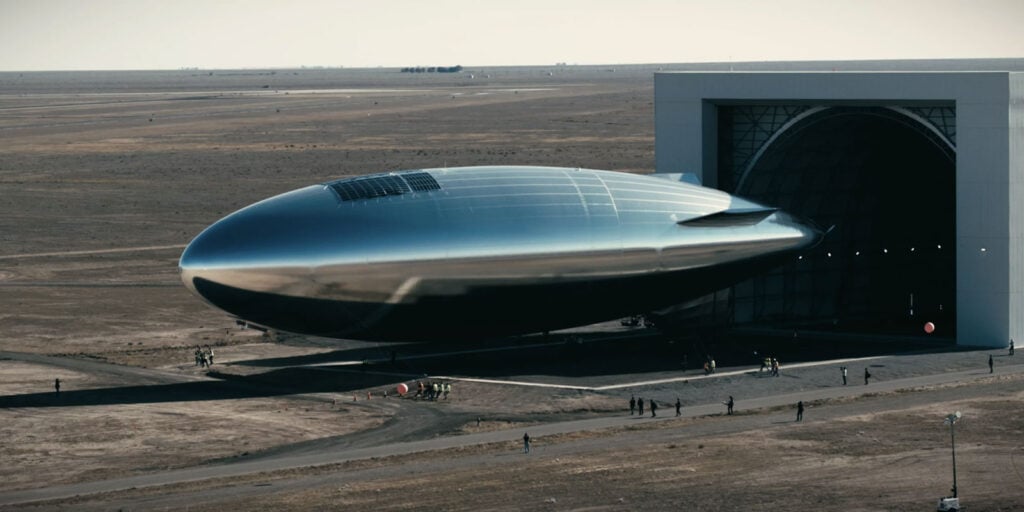
An American-engineered airship has completed a record-setting unmanned stratospheric flight, demonstrating unprecedented endurance for a solar-powered high-altitude airship.
Global broadband services received a glimpse into the future this spring, and the platform responsible was neither a satellite nor a conventional aircraft. Using its SE2 airship, Sceye (pronounced “sky”) of Moriarty, New Mexico, completed a 6,400-mi (10,300-km) stratospheric journey from New Mexico to the Brazilian coast.
“This is the defining step toward unlocking the stratosphere as a new layer of infrastructure,” Sceye founder and CEO Mikkel Vestergaard Frandsen told reporters during the company’s announcement, adding, “Endurance is what makes this possible.”
According to industry analysts, Sceye’s CEO is not overplaying the importance of this achievement. The flight marks a significant milestone for high-altitude platform systems (HAPS), which aim to combine the persistence of satellites with the flexibility of aircraft.
The 270-foot (82-m) SE2 is a solar-powered, helium-filled airship designed to serve as a high-altitude communications platform and environmental observatory. The platform can act as a floating cell tower and environmental monitor, maintaining station and remaining within a compact radius above target areas for days—or potentially weeks.
The flight demonstrates the platform’s potential to bridge the gap between satellites and terrestrial towers, eventually delivering 5G connectivity to remote regions while supporting continuous environmental monitoring, disaster response and emergency communications.
Using Hybrid Systems to Achieve Unparalleled Flight lengths
Like many high-altitude lighter-than-air platforms, the Sceye airship relies on a helium-filled envelope to reach the lower stratosphere. The inert, non-flammable gas provides the aerostatic lift needed to carry a 250-kg (550-lb) payload to altitudes of up to 65,000 ft (19,800 m), where the aircraft can remain aloft for extended periods.
Where the Sceye’s platform differs is that the airship uses a hybrid solar-electric power system to navigate, maintain station and power its communications systems. With the helium providing all necessary lift, the airship requires zero battery or solar power to stay aloft. Solar cells on the upper surface generate power during daylight and charge a lithium-sulfur battery pack with a specific energy of 425 Wh/kg (watt-hours per kilogram). Stored energy then powers the airship’s electric propulsion system throughout the night.
The key hurdle overcome by the SE2 is its ability to make and store enough energy to survive the darkness of 24-hour cycles, while navigating, fighting winds, and achieving performance objectives. Successfully meeting that energy requirement is what makes true multi-day endurance possible.
Spring’s Record-Setting Flight From New Mexico to Brazil
Sceye’s solar-powered SE2 High-Altitude Platform System (HAPS) lifted off from Roswell, New Mexico, on March 25 and completed its mission on April 6. During the transit, the airship operated above 52,000 ft (15,850 m), loitering for more than 88 hours over designated locations. According to Sceye, the flight is only the beginning. The company ultimately envisions platforms capable of remaining aloft for months—and eventually years—at a time.
HAPS is the umbrella term for aircraft designed to operate persistently in the stratosphere, encompassing both fixed-wing solar aircraft and lighter-than-air platforms. Companies such as Airbus have previously demonstrated the viability of fixed-wing HAPS for long-endurance surveillance, environmental monitoring, and communications.
Where Sceye’s approach differs is in its ability to carry substantially larger and heavier payloads. Previous models of fixed-wing HAPS optimize for endurance by minimizing weight; Sceye is pursuing a different philosophy: carrying payloads measured in hundreds of kilograms rather than single digits..
Why The Lower Stratosphere is the Sweet Spot for Communications
The lower stratosphere offers an operational sweet spot between satellites and conventional aircraft. Low Earth orbit (LEO) satellites repeatedly pass over an area but cannot remain overhead continuously, while geostationary satellites provide uninterrupted coverage from much greater distances, which lowers the achievable image resolution and signal strength for a given sensor or antenna.
Conventional aircraft can loiter over an area, but only for hours rather than days and at much lower altitudes. Ultra-light fixed-wing HAPS aircraft, such as the Airbus Zephyr, have demonstrated extraordinary endurance, but cargo capacity is hampered by their lightweight design.
Sceye’s airship is pursuing a different angle—sacrificing some altitude in exchange for the ability to carry substantially larger payloads. With an ideal operating range set between 52,000–65,000 ft (16–20 km), the increase in payload and impressive endurance opens the door for future HAPS airships to carry larger telecommunications equipment, advanced imaging systems and environmental sensors while remaining on station for extended periods.
The Company Behind the Airship
Sceye was founded in 2014 by Frandsen. Before founding Sceye, Frandsen led the development of humanitarian technologies, including the LifeStraw water filtration system and long-lasting insecticide-treated mosquito nets used in global public health programs.
Over the past decade, Sceye has progressively refined a series of increasingly capable prototypes, reaching the stratosphere in 2021 and completing its first full day-night (diurnal) flight cycle in 2024.
The success of Sceye is impressive, considering that decades of well-funded U.S. government efforts to develop persistent stratospheric airships failed to produce an operational platform. Several earlier U.S. military efforts, including the High Altitude Airship (HAA) program, demonstrated individual technologies, but they never fielded an operational persistent airship.
Even ambitious programs sponsored by DARPA and the Missile Defense Agency during the 2000s struggled to produce an operational vehicle. Many of the previous platforms faltered because engineers struggled to build envelopes capable of surviving repeated thermal cycling, pressure changes, and helium leakage in the harsh stratospheric environment.
Sceye appears to have overcome many of those challenges by engineering an airship capable of withstanding the demanding environmental conditions. Rather than attempting to solve every engineering challenge at once, Sceye allowed enabling technologies—including high-energy lithium-sulfur batteries, lighter envelope materials and more efficient solar cells—to mature before progressively expanding the capabilities of each new prototype.
Studying the Achievements of the SE2
In 2024, Sceye demonstrated that the SE2’s power system could sustain continuous operations through a complete day-night cycle. The 2026 mission built on that milestone, demonstrating sustained operations across multiple day-night cycles, varied terrain and an extended flight that included an ocean crossing.
To be most beneficial for telecoms, surveillance, or sensing, the platform must be able to maintain station over a service area rather than simply drifting with the prevailing winds. According to Sceye, the SE2 maintained a station-keeping radius as tight as 0.62 mi (1 km), an important milestone for a platform intended to function as persistent stratospheric infrastructure.
Sceye also noted that this mission validated the design of its first hull manufactured fully in-house, including the ability to maintain internal pressure across repeated thermal cycles. Like many non-rigid airships, the SE2 uses ballonets—internal air bladders that expand and contract to regulate helium volume as temperature and atmospheric pressure change.
Potential Applications for the SE2
The company envisions three primary commercial applications for the platform:
- Telecommunications: Sceye’s SceyeCELL airborne cellular antenna is designed to provide mobile connectivity from the stratosphere across wide areas, using beamforming technology to concentrate coverage where it is needed most.
- Environmental monitoring: Sceye’s infrared sensors are designed to detect methane plumes at meter-scale resolution. This is a level of detail that broad-coverage satellite instruments such as TROPOMI aboard Sentinel-5P are not designed to match.
- Wildfire detection and response: A persistent platform with continuous coverage over a regional area can flag a thermal anomaly within minutes of ignition, rather than waiting for the next satellite pass or a ground report. In fire-prone regions, faster detection could give response teams more time to contain small wildfires before they grow.
The logic is that one stratospheric platform can extend mobile coverage across a wide service area, particularly in places where towers are sparse, damaged, or impractical. According to Sceye, a pre-commercial demonstration flight planned for Japan later this year will integrate the platform with SoftBank Corp.’s cellular network, with disaster response and emergency communications serving as the primary demonstration objectives.
As for methane monitoring, company literature reports that a test flight last year identified an individual site in Texas releasing an estimated 2,205 lb (1,000 kg) of methane per hour, with data passed to the EPA. That level of resolution is operationally meaningful: it lets operators and regulators tie an emissions event to a specific location or facility rather than to a general region.
What’s Next
The pre-commercial demonstration flight in Japan later this summer will provide the next test of Sceye’s technology, determining if it can transition from a successful prototype to an operational service. If it does, the company’s recent flight from New Mexico to Brazil may be remembered not simply as a record-setting airship mission, but as the point when persistent stratospheric platforms began moving from decades of promise toward practical reality.
Sources and Further Reading:
- Solar-powered airship completes 12-day stratospheric flight test (Interesting Engineering)
- The Airship That Watches Everything — and Never Has to Land (Futurist Speaker, Thomas Frey)
- Stratospheric telecoms blimp completes “historic” record 12-day flight over Atlantic (The European)
- The 15 Million USD Blimp Taking Over the Sky (Interesting Engineering, video)
- Sceye press release: 12-day, 6,400-mile stratospheric flight


Responses