
China’s First Domestic Manned Airship, The AS700, Logs a Plateau Flight in Guizhou

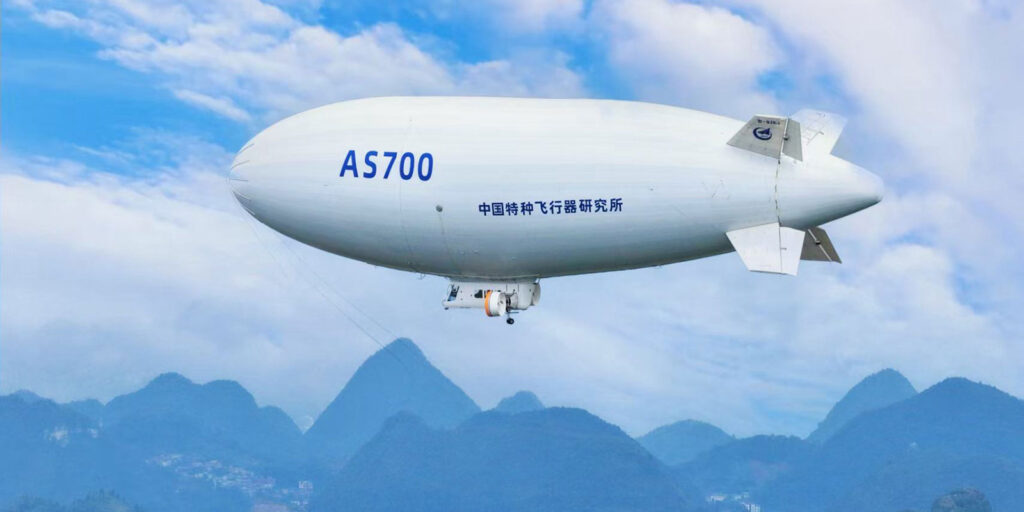
On Sept. 29, 2025, the airship’s developer, AVIC’s Special Vehicle Research Institute, announced that the AS700 had completed its first low-altitude plateau flight in the Guanling area of Guizhou Province. The airship operated at roughly 3,940 ft (1,200 m), according to the announcement. AVIC’s framing was a clean validation of stability and safety in plateau conditions, with the data serving future iterations and operational planning for southwest China.
The plateau test is a small step in a longer story, and it’s the longer story that makes the AS700 worth attention. This is the first manned airship China has designed, built, and certified domestically. Until very recently, the country had no domestic civilian airship industry to speak of. The AS700 is the deliberate first move toward changing that.
What was actually tested in Guizhou
Plateau flight is harder than sea-level flight for a buoyant aircraft. Thinner air means less net lift relative to weight, engine power output drops, and the weather adds wind shear and faster pressure swings that the ballonets have to keep up with. AVIC’s published service ceiling for the AS700 is around 10,170 ft (3,100 m), so a test at roughly 3,940 ft (1,200 m) is meaningful but not extreme. Guanling sits on the Yunnan-Guizhou Plateau, the high-elevation expanse that defines much of southwest China, and the choice of test site isn’t accidental. The region’s karst landscapes, river gorges, and terraced mountainsides are exactly the kind of scenery a slow, low-flying airship is perfect for showing off, and the southwest is where AVIC expects much of the AS700’s tourism business to land.
The pilot for the Guanling flight, Lin Hong, told Global Times the test “posed new challenges” beyond what the AS700 had encountered in earlier regions, citing the terrain and variable weather, but said the avionics and controls held up well in complex mountain conditions.
Meet the AS700
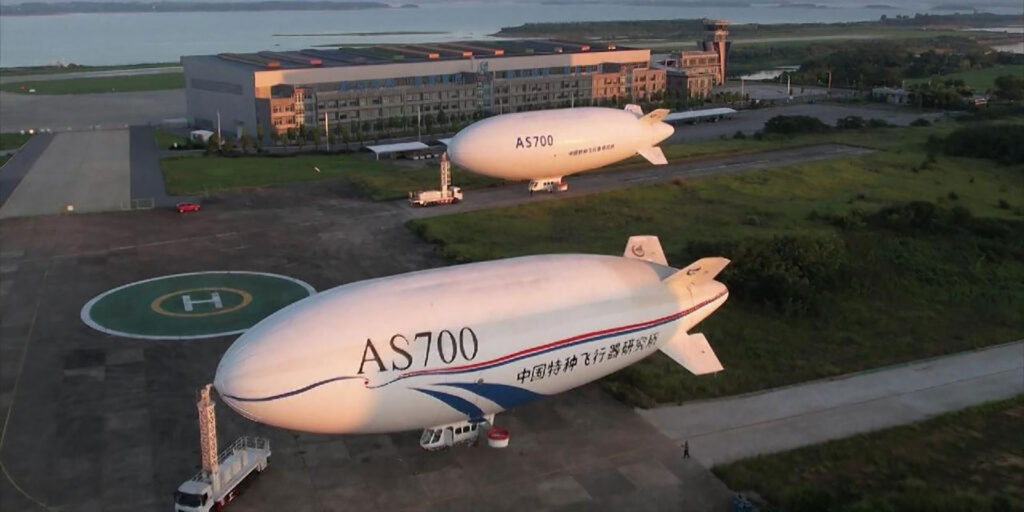
The AS700, branded Xiangyun (auspicious clouds), is a non-rigid helium airship. It measures roughly 164 ft (50 m) in length, with an envelope volume of around 123,600 ft³ (3,500 m³). It carries one pilot and up to nine passengers, with a maximum takeoff weight of nearly 9,150 lb (4,150 kg). Maximum range is 435 mi (700 km), endurance is up to 10 hours, top speed is 62 mph (100 km/h) with cruise closer to 37 to 44 mph (60 to 70 km/h), and the published service ceiling is around 10,170 ft (3,100 m).
The empennage uses an X configuration rather than the traditional cruciform layout, with the four fins arranged at roughly 45-degree angles instead of straight vertical and horizontal. Each fin works as a combined control surface, blending rudder and elevator inputs rather than splitting them between dedicated surfaces. The arrangement gives slightly better control authority for a given fin area, and on a single-wheel landing it keeps all four surfaces well clear of the ground, which a cruciform tail can’t always promise if the airship tilts back at touchdown. It’s an increasingly common choice on modern airship designs for those reasons.
Propulsion comes from two Lycoming IO-390-C3B6 piston engines driving thrust-vectoring ducted propellers near the rear of the gondola. AVIC has demonstrated VTOL and STOL operations in sites as compact as 492 to 656 ft (150 to 200 m) across. Landing gear is a conventional single-point arrangement under the rear of the gondola. Flight controls are fly-by-wire with a sidestick, and AVIC has stated the airframe can also be configured for uncrewed remote operation.
An electric variant, the AS700D, made its first flight in February 2025. It swaps the piston engines for a lithium-battery drive and is aimed at noise-sensitive and emissions-sensitive operations. The AS700D tops out at about 50 mph (80 km/h). Shanghai-based news outlet Sixth Tone reported its range at 37 to 44 mi (60 to 70 km) and endurance at about 1.5 hours, compared with 435 mi (700 km) and up to 10 hours for the piston-powered AS700.
Why China built it
The program began in August 2018 at AVIC’s Special Aircraft Research Institute in Jingmen, Hubei, and was developed in line with China’s policy support for general aviation, low-altitude tourism, and domestic aerospace manufacturing. The headline market case is aerial sightseeing. AVIC’s pitch, repeated consistently by project manager Du Wei and other officials, is that an airship cruising at around 37 mph (60 km/h) at low altitude, with large windows and a quiet ride, offers a different tourism product than helicopters or small touring planes. The “floating on clouds” framing has shown up in nearly every Chinese state media piece on the program.
Whether that demand actually materializes at scale is the genuine open question. AVIC has projected market demand for 100 AS700 units over a decade, which would be a strong result by modern airship industry standards. Confirmed orders stood at 42 as of late 2025, with early deliveries including Guangxi Guilin Ark General Aviation, which received an AS700 for sightseeing in Yangshuo, and a state-owned tourism group in Jiangsu. Zhejiang Airspace placed an order for 18 units in November 2025. Most early customers are state-owned or state-affiliated tourism operators, which means the demand signal is partly market interest and partly state direction. There isn’t yet enough operating revenue data to know whether airship sightseeing is a profitable venture that can scale in China.
The list of secondary missions intended are as follows: emergency rescue, urban security, aerial surveying, aerial photography, mineral prospecting, marine surveillance, police patrols, and small cargo to remote areas. These are the missions that would partly occupy a larger fleet if tourism proves out. For now they’re secondary to the sightseeing thesis.
The “low-altitude economy” angle
The AS700 sits within a Chinese policy concept usually translated as the “low-altitude economy,” meaning commercial aviation below roughly 3,281 ft (1,000 m): drones, sightseeing helicopters, light general aviation, eVTOLs, and now airships. The term originated in Chinese policy and has since spread to international industry usage, though not necessarily in a regulatory context as it is in China. As a concept in China it is the banner under which central policy, airspace regulation, certification, manufacturing support, pilot training, and provincial incentives are coordinated. The AS700 benefits from all of it. Its CAAC certification path, the gradual opening of sub-3,281 ft (1,000 m) airspace, the buildout of a domestic airship pilot training program, and the regional push in southwest China are all expressions of the same policy architecture. The CAAC has estimated the sector at 1.5 trillion yuan in 2025 and forecasts its growth to exceed 3.5 trillion yuan by 2035, figures that are government estimates rather than measured market data.
Where things stand
The AS700 received its CAAC type certificate in December 2023, was delivered to its first customer in September 2024, and is on track to receive its production certificate by the end of 2025, clearing the way for serial manufacturing. By AVIC’s count, the prototype fleet has logged 187 test flights totaling 602 flight hours. The Guanling plateau test adds another data point and broadens the conditions in which the AS700 has been demonstrated.
The AS700 isn’t a flagship of airship innovation. It’s a conventional non-rigid using mature technology, conservatively engineered. What’s notable is the program around it: a sustained effort to prop up a domestic Chinese airship industry from scratch, executed through a single integrated manufacturer, with regulatory procedures and customer infrastructure built in parallel. The plateau flight in Guizhou is a small step. The fact that it’s happening at all, in a country that had no civilian airship industry seven years ago, is the bigger story.
Sources and Further Reading:



Responses