
Sceye’s Stratospheric Airship Completes Record-Breaking 30-Day Round Trip to Japan

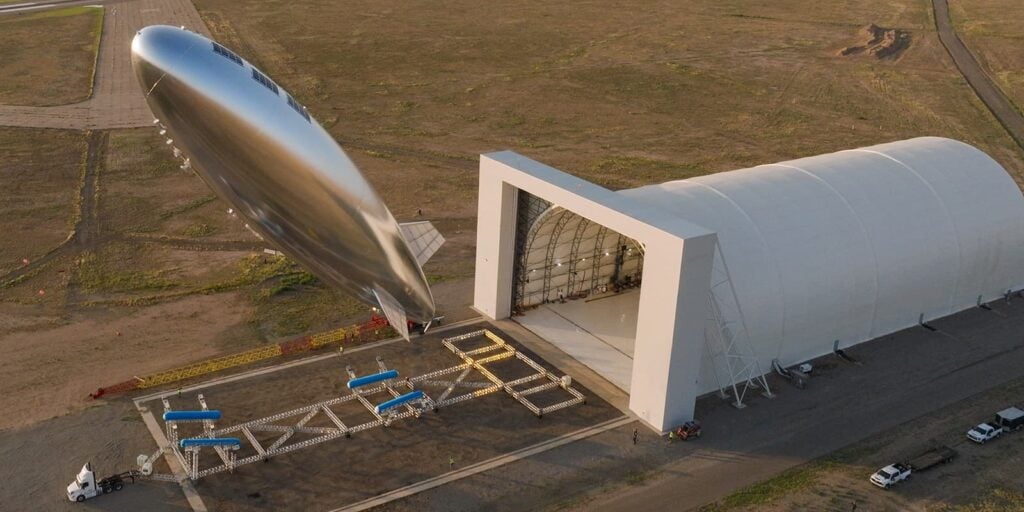
Sceye’s airship covered nearly 30,000 kilometers on a month-long mission that tested long-distance navigation, station-keeping and direct-to-phone connectivity from the stratosphere.
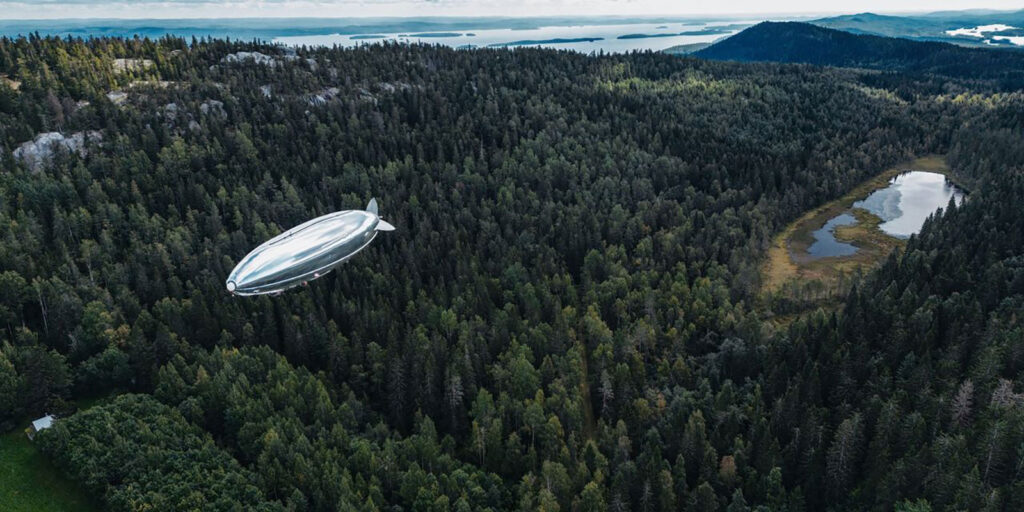
Sceye’s Service Test 1 (ST1) is back in New Mexico after a 30-day round trip to Japan, marking a major milestone in the company’s effort to develop airborne communications services using unmanned aerial platforms.
The mission was the first flight in Sceye’s Service Test Program and its first flight to Asia. The American-based company is developing airships designed to operate as communications links similar to geostationary satellites, but much closer to Earth and capable of remaining over a particular area.
The uncrewed High-Altitude Platform System (HAPS) lifted off from New Mexico at 7 a.m. local time on August 9 and reached Japan 13 days later, after travelling more than 9,300 miles (15,000 km) through the lower stratosphere. After spending just over seven days in Japanese airspace, ST1 turned for home and re-entered the continental United States on September 4.
The airship reached Sceye’s headquarters airspace above Moriarty, New Mexico, on September 5, where the company conducted additional vehicle tests before a planned flight termination and controlled descent.
Crossing the Pacific and Returning Home
Sceye says the total journey covered nearly 30,000 km (18,600 miles), breaking distance records for this type of craft on a cross-Pacific round trip. The mission did not, however, set a stand-alone endurance record.
The current record for this class of high-altitude platform belongs to Airbus/AALTO’s Zephyr, whose 2025 flight remained aloft for 67 days, 6 hours and 52 minutes. The two platforms differ significantly: Zephyr is a solar-powered fixed-wing aircraft, while ST1 is a lighter-than-air platform.
Zephyr resembles a conventional aircraft, with a long, slender wing covered in solar cells. Because it relies on aerodynamic lift, it must remain in continuous forward flight, whereas ST1 can float and station-keep over a particular area—an important distinction between Sceye’s platform and conventional aircraft.
Sceye’s Japan mission demonstrated that its solar-powered platform can cross an ocean, operate for weeks in the lower stratosphere, hold position over a target area, and provide cellular connectivity directly to ordinary smartphones from roughly 16 kilometres above Earth.
Creating a Cellphone Tower in the Sky
Another major milestone came through Sceye’s partnership with SoftBank. The companies describe the mission as the world’s first successful intercontinental test of a mobile core network and web server operating on a HAPS.
ST1’s main communications payload was SceyeCELL, an antenna system designed to deliver wide-area mobile broadband directly to standard smartphones from the stratosphere. The platform processed data onboard rather than routing it through distant cloud data centers, an approach known as edge computing. The onboard web server processed responses and relayed them directly back to smartphones.
The companies reported an average communication round-trip response time of 68 milliseconds, claiming a latency reduction of more than 40 percent compared with internet-based cloud processing.
SoftBank President and CEO Junichi Miyakawa said the Japan trial gave the company “gained confidence to realize a three-dimensional communications network utilizing HAPS.” SoftBank describes the project as laying the groundwork for a three-dimensional network connecting the ground, sky and space—essentially putting a cellphone tower about 17 km above Earth.
ST1 was able to station-keep within a 3-mile (5-km) communications area, demonstrating how precisely the platform could maintain its position over the target.
During the mission, ST1 connected ordinary, unmodified smartphones to SoftBank’s network. Demonstrations included:
- text messaging
- voice calls
- internet access
- video streaming
- emergency communications
Emergency-response testing included voice calls to Japan’s maritime emergency number, 118, conducted in cooperation with the Japan Coast Guard. The tests also included earthquake and tsunami alert messages and communications with drones.
Previous Work with U.S. Government Agencies Comes into Play
Sceye has previously worked with NASA and the U.S. Geological Survey on HAPS applications for environmental monitoring and disaster response, something that played into the week-long Japan tests. The company says the technology could eventually support communications in rural and remote areas where conventional infrastructure is damaged or unavailable.
Sceye lists ST1 potential applications as including:
- emergency response
- long-endurance communications with drones
- environmental monitoring, wildfire and severe-weather observation
- military and government communications
- future 5G/6G backup infrastructure
Sceye said the Pacific flight confirmed communications performance comparable to terrestrial networks while reducing radio interference with ground-based base stations. At full scale, the company says a single platform could provide coverage equivalent to roughly 500 ground-based cell towers.
Meeting Another Important Milestone
The Pacific mission follows an earlier flight from New Mexico to Brazil, an energy and endurance test lasting more than 12 days. That flight covered more than 6,400 miles (10,300 km) and focused on night operations, testing whether ST1 could maintain its day-night power cycle. Sceye said the mission demonstrated the platform’s ability to meet its power requirements through the night and helped pave the way for the next phase of testing: communications and endurance in the South Pacific.
The Japan mission addressed goals Sceye outlined in April, when the company said its first pre-commercial flight would establish a backhaul link carrying traffic from the airborne cell site into SoftBank’s core network and demonstrate expanded connectivity for emergency and disaster response.
How Sceye’s HAPS Stay Aloft
Sceye’s HAPS are uncrewed platforms designed to remain in the stratosphere for extended periods, providing a communications layer between conventional cell towers and satellites.
The company describes its platforms as operating similarly to geostationary satellites, but about 1,800 times closer to Earth.
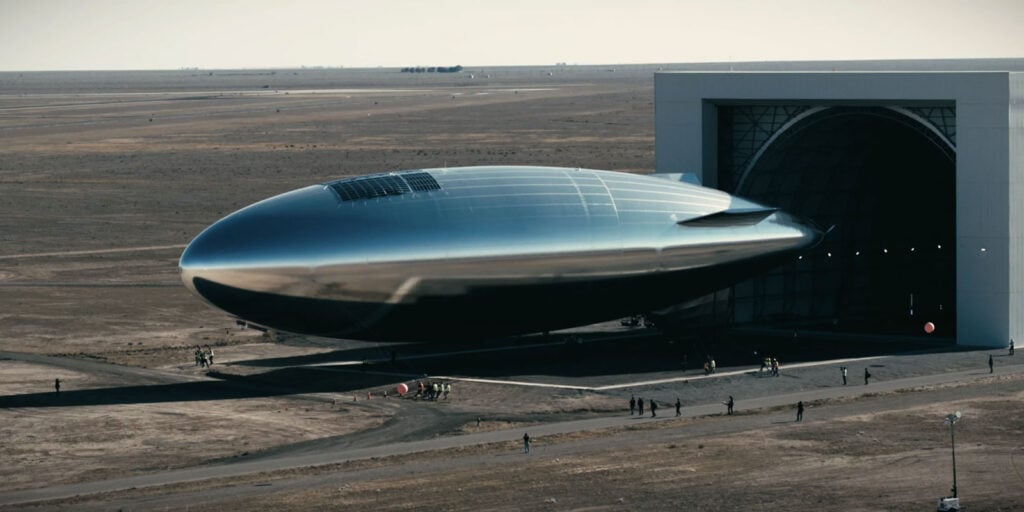
ST1 is a helium-filled airship with solar cells across the top of its hull. The solar array provides power during daylight and charges batteries for overnight operation. Electric motors and propellers provide propulsion and maneuvering.
While the ST1 has most commonly been referred to as an airship, there was an interesting wrinkle in the terminology of the craft after the Japan trip. Photo captions accompanying the September 9 press release describe the platform as operating as an “unmanned free balloon” during the mission.
Sceye has used similar terminology before. In a May blog post marking the centennial of the airship Norge, the company described its platform as “at its core, an unmanned free balloon” that relies on passive buoyancy and global wind currents. An assistive navigation system allows the platform to counter winds, hold position over an area or move between wind currents.
Was ST1 Spotted Over San Diego?
According to witnesses on the ground, ST1’s return leg may have passed over San Diego.
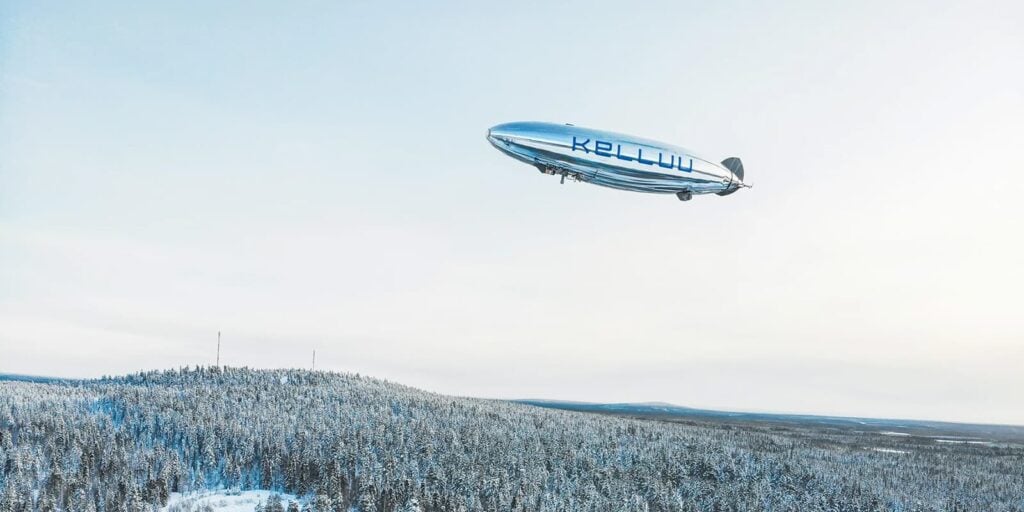
On the afternoon of Friday, September 4—the same day Sceye says ST1 re-entered the continental United States—residents reported seeing a small, reflective, blimp-shaped object high overhead.
Local news site SanDiegoVille reported that flight-tracking screenshots identified the object as HBAL124, registration N519HB, classified as a high-altitude balloon. While Sceye has not publicly confirmed that the object was ST1, N519HB appears as the flight identifier on several earlier Sceye test flights logged by StratoCat, a database of stratospheric balloon launches.
At one point, the object was reportedly at about 53,800 feet (16.4 km), an altitude consistent with ST1’s operating range. It was also reported to be travelling at roughly 53 knots (61 mph or 98 km/h) over San Diego County.
Sources and Further Reading:
- Sceye: ST1 return announcement (September 9, 2026)
- Sceye via PR Newswire: ST1 return announcement, with mission photo captions
- Sceye via PR Newswire: Sceye and SoftBank Corp. complete stratospheric connectivity demonstration in Japan (September 2, 2026)
- SoftBank Corp.: Japan’s first HAPS trial service (September 2, 2026)
- Sceye via PR Newswire: SE2 Endurance Program flight to Brazil (April 13, 2026)
- Sceye: Celebrating 100 Years Since Norge Airship (May 21, 2026)
- AeroTime: Sceye high-altitude airship flies from US to Japan through stratosphere
- Gizmodo: Sceye’s ST1 round trip to Japan
- AOL: Syndicated Gizmodo report
- Mediasat: Sceye’s airship flies US-Japan round trip
- SanDiegoVille: High-altitude airship spotted above San Diego
- Postimees Tehnika (Estonian): Stratospheric craft’s 15,000 km flight to Japan
- StratoCat: Sceye stratospheric platform flight record, September 22, 2025

Responses