
Moffett’s Airship Cathedral Is Whole Again, but the Future Remains Uncertain

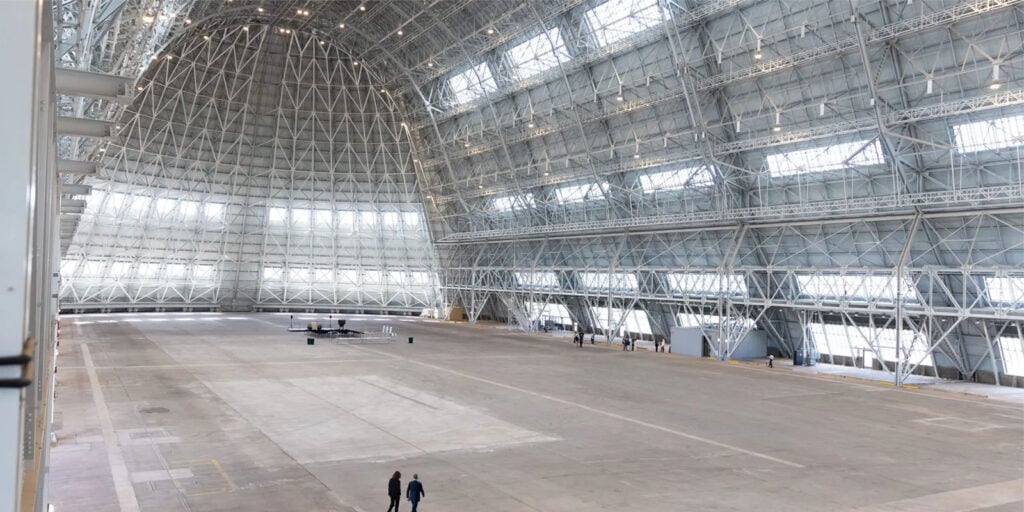
Once reduced to its skeletal frame, one of America’s few surviving rigid-airship hangars has been rescued, the result of a massive, decades-long restoration.
Despite a storied past as the home base for the U.S. Navy’s giant rigid airship USS Macon, Hangar One at Moffett Federal Airfield fell into a slow decline. At one point, the site near Mountain View, California, was named to the National Trust for Historic Preservation’s list of America’s 11 Most Endangered Historic Places. After its closure in 2003, its future appeared increasingly bleak—until this year.
Planetary Ventures, Google’s real estate subsidiary, has now completed a massive, multi-million-dollar refurbishment. On March 20, 2026, NASA Ames officials, Google representatives, and longtime preservation advocates gathered inside the reborn structure to mark the completion of a daunting restoration project that, for years, seemed unlikely to ever finish. The one question left largely unanswered during the celebration was also the simplest: What comes next?
The Creation of a Google and NASA partnership
Google’s subsidiary found itself at the helm of Hangar One’s repair after winning a competitive bid established by NASA over a decade ago. The restoration was required under the terms of a 60-year lease for Moffett Federal Airfield, with the repair of the hangar listed as a non-negotiable obligation.
According to NASA’s project statement, work focused on modernizing the structure while maintaining its original visual characteristics as closely as possible. The task was no small undertaking, either; The hangar is among the largest free-standing structures in the world, according to Chris Alwan, district director of Planetary Ventures. Covering an impressive eight acres (3.2 hectares), the mammoth expanse is such that fog sometimes gathers near its 198-ft (60-m) high ceiling.
Historic Ties to America’s Flying Aircraft Carriers
Measuring 308 ft (94 m) wide and 1,133 ft (345 m) long, the hangar was large enough to house the USS Macon, the U.S. Navy’s giant rigid airship and flying aircraft carrier. At 785 ft (239 m) in length, the Macon could launch and recover Curtiss F9C Sparrowhawk biplanes through a trapeze system housed inside its hull. It was one of just two airships of its class, alongside the USS Akron.
Together, the dirigibles represented the pinnacle of American rigid airship development. For a brief period in the early 1930s, Hangar One housed what many believed was the future of long-range naval aviation—a concept that disappeared almost overnight with the loss of Akron in 1933 and Macon in 1935.
How a Monument to Airship Aviation Became an EPA Superfund Site
The hangar’s slow-motion crisis began in 1998, when NASA discovered polychlorinated biphenyl (PCB) contamination in a storm drain basin at Ames Research Center. By 2002, investigators had traced the contamination to the composite siding panels installed during the original construction. Lead paint and asbestos in the siding and frame paint compounded the problem. As retired Navy flight engineer Jake Gale put it at the unveiling, “It was quite a cocktail of contaminants.”
The Navy’s initial response was to consider a complete demolition. That proposal sparked immediate opposition and ultimately united an unlikely coalition: preservationists, environmental advocates, former military personnel, business leaders, and elected officials came together under the banner of the Save Hangar One Committee. Led by former Sunnyvale mayor Otto Lee and other local advocates, the coalition united with a common goal—saving one of the country’s most recognizable aviation landmarks.
The Navy ultimately backed off demolition. Instead, between 2010 and 2013, it removed the hangar’s contaminated exterior siding, roof, windows, and doors before coating the exposed steel framework with a protective epoxy sealant. At the time, critics—including former NASA Ames deputy director Bill Berry—argued that the interim solution did not go far enough. They warned that the epoxy coating offered only temporary protection and that any future failure of the seal could expose the lead-based paint beneath.
NASA Finds a Long-Term Partner
Despite intense public pressure to preserve the site, NASA did not have the budget to finish what the Navy started. Unable to fund the restoration alone, NASA sought a private-sector partner by offering a long-term lease for the roughly 1,000-acre (405-hectare) Moffett Federal Airfield. Planetary Ventures emerged as the successful bidder under a 60-year lease giving Google’s subsidiary operational control of the airfield in exchange for $1.16 billion in rent over the life of the deal.
NASA also estimated the lease would save the agency roughly $6.3 million annually in maintenance and operating costs, while requiring Planetary Ventures to invest more than $200 million in the property, with Hangar One as the centerpiece of those commitments.
In return, Google secured long-term access to one of Silicon Valley’s most unusual properties—a federally owned airfield just four miles (6.4 km) from the company’s Mountain View headquarters. Included on the site are three enormous, historic hangars, two runways, a golf course, and one of the largest enclosed workspaces in the region. What the famous airship hangar will actually be used for is still being worked out.
The Unanswered Question
What no one at the March 20 event was prepared to discuss in detail was: what happens next? The lease does require Planetary Ventures to operate an educational facility open to the public, but the language is broad, and Google has not yet committed to anything more specific. “We’re still working on it,” he said, “But we’re committed to innovation.”
Lighter-than-air advocates and local community members have pressed for years to have at least part of the building dedicated to a public museum for Hangar One, the USS Macon, and the broader history of American rigid-airship development. Former U.S. Representative Anna Eshoo, the project’s most consistent political advocate over the decades, has named a museum as a priority.
Airship Advocates Hoping for a Historical Display
For an airship audience, Google’s ambiguity might just be the most interesting part of the story. Hangar One is one of the country’s most important surviving structures from a lost era in aviation, and the public desire appears to be for Google to embrace that heritage through the creation of a Macon-focused LTA history museum.
For the moment, it is enough that the hangar is whole again, watertight, and no longer toxic. The harder question of what to put inside it has been handed to a tenant who has another five and a half decades to figure it out. Whatever Planetary Ventures ultimately decides to do with the site, the lease reflects a long-term investment in infrastructure that is unlike anything else in Silicon Valley.
Timeline of Hangar One
- 1933: The United States Navy completes Hangar One at Naval Air Station Sunnyvale, home base for the USS Macon and the lighter-than-air aviation program.
- 1935: USS Macon is lost off the California coast, effectively ending the Navy’s rigid-airship program. Although Hangar One remained in use, it would never again house a rigid airship.
- 1936: Hangar One and all of Naval Air Station Sunnyvale enter a period of shared use with the U.S. Army, and the site is renamed Moffett Field Army Air Corps Base.
- 1942: Moffett Field returns to U.S. Navy control, used as a major base for coastal blimp operations during World War II.
- 1994: The Navy transfers Moffett Field to NASA.
- 1998: NASA announces finding PCB contamination in a storm drain settling basin.
- 2002: Sampling determines that the building’s original corrugated exterior siding is the primary source of the PCB contamination. Investigators also confirm the presence of asbestos and lead-based paint.
- 2003: Hangar One is closed due to environmental and safety concerns.
- June 2010 – June 2013: The Navy strips the structure to its bare framework before applying a protective epoxy coating to the exposed steel.
- February 2014: The U.S. General Services Administration and NASA selected Planetary Ventures as the preferred lessee, beginning negotiations on a long-term lease that includes restoring Hangar One
- Dec. 1, 2025: Planetary Ventures completes restoration of Hangar One.
Sources and Further Reading:
- New Atlas: Google’s restoration of the mammoth Hangar One now complete
- Mountain View Voice: Google unveils historic restoration of Hangar One in Mountain View
- NASA Ames: Hangar One Restoration Project
- EPA: Naval Air Station Moffett Field Superfund site
- National Trust for Historic Preservation: 2008 list of America’s 11 Most Endangered Historic Places




Responses