
A Century On, the USS Shenandoah’s Crew Is Remembered in Ohio

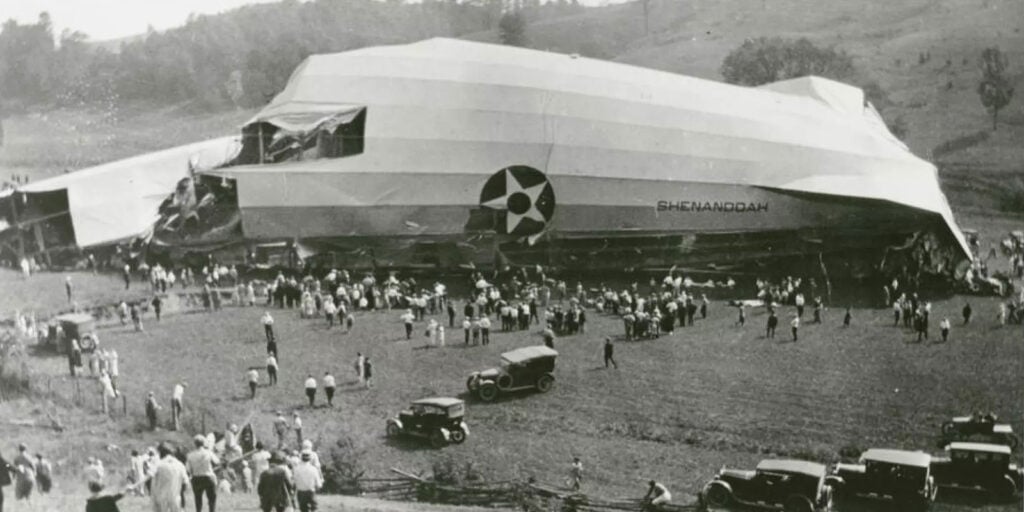
One hundred years after the USS Shenandoah broke apart in a predawn squall over the hills of Noble County, the ship’s crew was honored at the site of the crash. On August 31, 2025, the Sunday nearest the anniversary, descendants, local historians, students, and Navy representatives gathered at the Shenandoah Monument in Ava, Ohio, for the centennial commemoration of the September 3, 1925 crash. A smaller, more intimate observance was planned for September 3rd itself. Of the 43 men aboard the U.S. Navy’s first rigid airship that night, 14 were killed, including her commanding officer, Lieutenant Commander Zachary Lansdowne.
The Shenandoah, designated ZR-1, was the first rigid airship built in the United States and the first in the world to be inflated with helium rather than hydrogen. Her loss came more than a decade before the Hindenburg, and although it has faded from broader public memory, in southeastern Ohio it never has. The 100th anniversary brought that local memory back into focus, with services on the Ohio crash field, a separate gathering at the airship’s birthplace in Lakehurst, New Jersey, and a program planned at the Garst Museum in the captain’s hometown of Greenville, Ohio.
A pioneering ship and her final flight
The Shenandoah was assembled at Naval Air Station Lakehurst in 1922 and 1923 from components fabricated at the Naval Aircraft Factory in Philadelphia. Her design was modeled on the German wartime Zeppelin L 49. She measured 680 ft 2 in (207.3 m) in length, was held in shape by a duralumin internal skeleton (the defining feature of a rigid airship, as distinct from a blimp, which holds its shape through internal gas pressure alone), and was lifted by twenty gas cells filled with helium, then an expensive and even more scarce resource that the U.S. Navy had committed to in place of flammable hydrogen. Five 300-horsepower engines drove her forward.
Christened by Marion Denby, wife of Secretary of the Navy Edwin Denby, the ship took her name from Virginia’s Shenandoah Valley, a name often rendered as “daughter of the stars.” Over the next two years she flew more than fifty missions, including the first transcontinental flight by a rigid airship in 1924, a round trip from Lakehurst to Washington State that helped justify the Navy’s investment in lighter-than-air craft.
By the late summer of 1925, the Shenandoah was scheduled for a Midwest publicity tour, including a flyover of the Ohio State Fair and visits to several other state fairs. She left Lakehurst on September 2 and made it across Pennsylvania without trouble. Early on the morning of September 3, she ran into a line of severe thunderstorms over eastern Ohio. Strong vertical air currents tore the ship apart near Ava. Her control car separated from the hull and fell, killing Lansdowne and several officers with him. The stern section came down nearby. The bow, with men still aboard, drifted roughly six miles south before the surviving crew managed to bring it to the ground. The Navy lost 14 men. Twenty-nine survived.
The ceremony at Ava
The centennial service was held at the Shenandoah Monument on Ohio Route 821, the site of the crash and the place where the local community has gathered for major anniversaries for decades. Theresa Rayner, who organizes the monument’s program and runs a mobile museum dedicated to the airship, framed the day around the crew rather than the spectacle of the disaster.
“We believe these airmen were pioneers in the field of lighter than air, and that they deserve to be recognized for the service and the sacrifice that they made for this lighter than air program that the navy had started in the 1920s,” Rayner said.
Attendees heard from local officials and saw a performance by the Shenandoah High School Band, named for the ship that came down in their county. Ohio State Senator Brian M. Chavez spoke about the designation of a portion of I-77 in Noble County as the U.S.S. Shenandoah Memorial Highway, legislation that he sponsored. The stretch passes near one of the crash sites and is marked by a brown commemorative sign. “And that helps us keep this alive, so it doesn’t fade into history, because the Shenandoah has edged deep into history in Noble County and now, we want to share that with the rest of the nation and the rest of the world,” Chavez said.
Local families have been the engine of preservation in Noble County for the better part of a century. After the crash, residents pulled artifacts from the wreckage, some of which are now displayed at the county courthouse, including the airship’s steering mechanism, donated by a local family. Rayner, whose late husband’s grandfather owned land where two of the crash sites are located, has spent years gathering photographs, fragments, and personal effects from the ship. One descendant of a witness, identified only as Chris, urged neighbors at the ceremony to look through their barns and attics for anything still surviving and to write down their family stories before the firsthand connections are gone.
A second tribute at Lakehurst
The Shenandoah was born at Lakehurst, and Lakehurst remembered her too. Members of the Navy Lakehurst Historical Society and American Legion Post 129 of Toms River gathered at the Cathedral of the Air in Lakehurst, New Jersey, to mark the centennial. The ship had risen from that field on her maiden flight on September 4, 1923, lifted out of her enormous hangar by hundreds of Navy personnel pulling on lines. It was the start of the U.S. Navy’s rigid airship era, which would eventually include the USS Los Angeles, USS Akron, and USS Macon.
Lansdowne, Greenville, and a museum talk
Lansdowne was 36 when he died. He was born December 1, 1888, in Greenville, Ohio, attended the local schools, and entered the U.S. Naval Academy in 1905, graduating in 1909. He served on the destroyer USS McCall and the battleship USS Virginia before training in lighter-than-air operations, including time in England, and was named commanding officer of the Shenandoah in February 1924. He is buried at Arlington National Cemetery. His childhood home in Greenville, at West Third and Locust Streets, is on the National Register of Historic Places.
Lansdowne’s reluctance to make the September flight has long been part of the historical record. The findings of the Navy court of inquiry, published in the U.S. Naval Institute’s Proceedings, document that he wrote to Admiral Edward Eberle, the Chief of Naval Operations, on June 15, 1925, recommending that the Midwest flight be postponed because of likely unfavorable weather in July and August. After later recommending two separate flights, with the broader Midwest route beginning September 7, Lansdowne was instead ordered to make one flight beginning September 2. His widow, Margaret Ross Lansdowne, would testify pointedly at the inquiry that publicity had been allowed to override prudence, a charge that helped reshape public conversation about how the Navy was using its airships.
To mark the anniversary in Lansdowne’s hometown, the Garst Museum in Greenville scheduled a free Speaker Series program for October 18, 2025, featuring Leroy Clouser, who has researched extensively on the Shenandoah, Akron, and Macon rigid airships. The museum also maintains a permanent exhibit on Lansdowne and the Shenandoah in its Keepers of Freedom section.
What the disaster left behind
The Shenandoah crash was, at the time, one of the worst aviation disasters in American history, and it forced changes in how the Navy thought about rigid airships. The investigation prompted revisions in structural design and questions about how the ships were being scheduled and used, particularly the practice of sending them on long publicity tours through unfamiliar weather. Despite the hard-won lessons influencing changes toward future rigid airships, the Akron and Macon programs of the early 1930s would both also end in storm-related losses. Other gains, however, including helium-handling practices and structural standards, carried into the decades of lighter-than-air work that followed at Lakehurst and elsewhere.
Rayner returned to that point at the Ava ceremony. “Even though this was a disaster, and the airship did not fare well, things are still learned from our mistakes, and a lot of them feel that aviation was enhanced because of this experiment of airship,” she said.
A century later, the Shenandoah’s crew is remembered less for how they died than for what they were trying to do: prove out a new kind of flight in a new kind of ship, on behalf of a service still working out what airships could and couldn’t be asked to do. The monument in a Noble County field, the brown sign on the interstate, the high school and marching band that carries the ship’s name, the mobile museum built around a sugar bowl and a length of gear wire, all of it points back to that same fateful day and the 14 men who were lost.
Sources and Further Reading:
- USS Shenandoah’s centennial commemorates 1925 airship tragedy (WTOV)
- Anniversary of Shenandoah crash remembered (Daily Advocate)
- Findings of the “Shenandoah” Court of Inquiry (U.S. Naval Institute Proceedings, February 1926)
- Shenandoah III (ZR-1) (Naval History and Heritage Command)
- ZR-1 U.S.S. Shenandoah (airships.net)
- Shenandoah Crash Sites (National Park Service)
- 100 Years After the Death of the U.S.S. Shenandoah (Ohio History Connection)
- Event scheduled to commemorate anniversary of Shenandoah disaster (Marietta Times)
- Ohio Senate: Governor Signs Highway Memorial Naming Bill
- Ohio Revised Code 5534.672, U.S.S. Shenandoah Memorial Highway
Responses