
Aeros’ Ambitious Plans for a Flying Warehouse Begin with Modest Blimp Trials

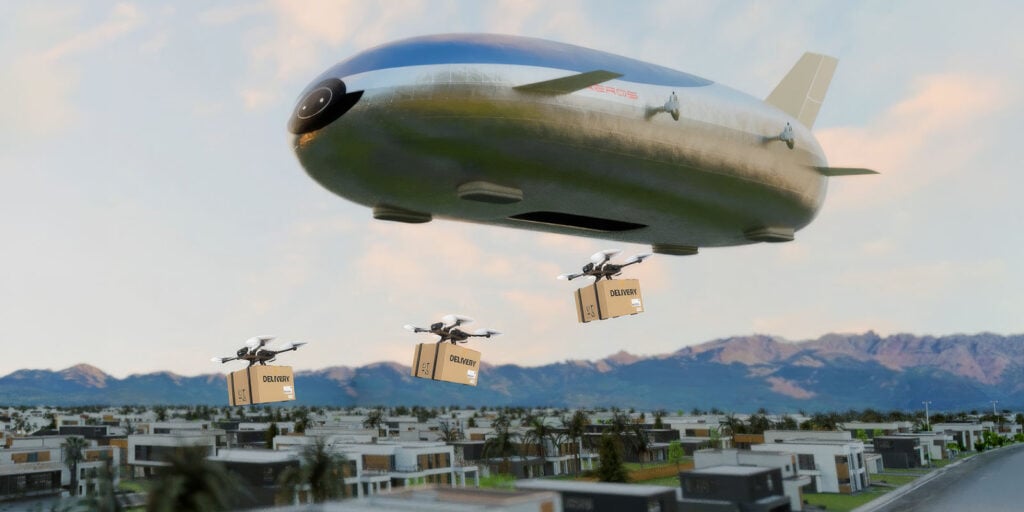
Worldwide Aeros Corporation, a Southern California airship company founded by Igor Pasternak, wants to do something futuristic enough that it sounds unlikely until you look closer: float a giant airship over Los Angeles to launch and recover delivery drones and eventually operate a full-scale airborne fulfillment center.
The company has been moving closer to that goal in concrete steps. In November 2024, Aeros began testing delivery drones from California-based drone manufacturer A2Z Drone Delivery and Austria-based drone maker AIR6 Systems with its Sky Dragon airship as part of its planned airborne fulfillment center program. Aeros has continued working toward an operational drone-delivery demonstration over Greater Los Angeles using its existing 40D and 40E Sky Dragon airships. In September 2025, Pasternak told aviation trade publication FlightGlobal that trial flights were targeted before the end of this year. As of this publication no tests have been verified.
The plan has two phases. The near-term phase is a proof-of-concept demonstration using an existing Aeros surveillance blimp. The long-term phase is the Aeroscraft, a rigid, variable-buoyancy heavy-lift airship that, in its largest proposed form, would approach Hindenburg size. Whether the company can actually build the latter is a separate question from whether the former can fly, and Aeros is betting that demonstrating the small version could help unlock the capital for the big one.
A decades-old airship builder
Aeros is not some fly-by-night startup. The company was founded by Pasternak in Lviv, in what is now Ukraine, in the late 1980s under Gorbachev’s Perestroika reforms, relocated to California in the mid-1990s, and has been producing airships ever since. Its current production airship is the Sky Dragon 40E, a non-rigid airship (or ‘blimp’) with a 113,000 ft³ (3,200 m³) gas envelope and seating for a pilot plus six passengers. Like many modern airships, the Sky Dragon uses vectored thrust (engines that swivel to push air in different directions) for low-speed maneuverability.
Aeros has sold these airships internationally and supplied tethered aerostats to the U.S. military for surveillance work in Afghanistan and Iraq. So when Pasternak talks about flying a Sky Dragon over Los Angeles, he is talking about an aircraft his company has successfully built and flown for decades.
The trial run: a small blimp, some drones, and a test market
For the demonstration, Aeros plans to use a Sky Dragon with a payload of roughly 1,980 lb (900 kg). Drones would launch from the airship, deliver packages within a defined service area, and, under the company’s concept, return to the airship to be reloaded. Aeros has partnered with ShipBots, a fulfillment and logistics company, for logistics handling, and is separately working with the previously mentioned drone suppliers. The goal at this stage is not to run a meaningful piece of LA’s e-commerce traffic; it is to demonstrate that the fulfillment system is operationally viable and that regulators will approve the idea of a drone mothership delivering packages over a major city.
That regulatory question remains open. Aeros says the airship would operate at around 1,200 ft (366 m) above ground level, while small commercial drones are generally restricted to 400 ft (122 m) by FAA Part 107 rules. Bridging that gap would likely require FAA approval beyond ordinary Part 107 operations, whether through waivers, exemptions, airspace authorization, or a more tailored operational framework. Pasternak has said publicly that the FAA is engaged on the concept.
COSH: the buoyancy trick that makes the whole idea work
The reason Aeros believes its proposed airships can succeed as flying fulfillment centers where decades of similar concepts have failed is because of the company’s own proprietary system that it calls Control of Static Heaviness, or COSH.
Airship operators control the buoyancy by making adjustments to ballast (water or sand) or by venting off lifting gas. To ease buoyancy management, an airship is typically flown slightly heavier than air so that dynamic lift from the engines and the hull at an inclined pitch provide remaining lift. The difficulty is that when an airship offloads heavy cargo, it suddenly experiences a dramatic increase in net buoyancy, and venting the excess helium to compensate would be very expensive. Loading and unloading an airship without a ground crew, mooring mast, or ballast exchange is no easy feat, and that limitation would be a nonstarter for an airborne fulfillment center with cargo continuously arriving and departing. If more dynamic lift were used to offset these issues, the operation would become more costly due to the continuous fuel consumption required to maintain altitude.
COSH addresses these problems by compressing helium out of the lifting volume and into pressure tanks inside the hull. It effectively functions as a conversion of lifting gas into a gaseous ballast. Instead of valving off helium, it is compressed until it becomes denser than the surrounding air. Thus gas lift is reduced while gross weight marginally increases. This dual action mechanism creates a closed buoyancy system where ground connections to replenish helium or ballast become unnecessary. With COSH, the helium can be released back into the envelope, and the airship will become lighter again. Pasternak compares it to a submarine’s ballast system, which is a fair analogy: a sub adjusts buoyancy by flooding or blowing its ballast tanks, and COSH does something similar in principle with a lifting gas instead of seawater.
Aeros successfully demonstrated COSH in a ground test in 2006 and in flight on a modified Sky Dragon in 2008, both under DARPA’s Project Walrus. The company’s larger demonstrator, the Pelican (later renamed Dragon Dream), was a roughly half-scale Aeroscraft prototype with a 600,000 ft³ (16,990 m³) envelope. It received an FAA experimental airworthiness certificate and conducted further test activity in 2013 before being damaged later that year when part of the roof of its leased WWII-era Tustin hangar collapsed. Despite the setback, Aeros has continued advancing the Aeroscraft and COSH on paper, receiving a U.S. patent for the COSH system in 2015 and progressing the design of full-scale Aeroscraft variants. The company now hopes the LA Sky Dragon drone trial and its ShipBots delivery contract will make a compelling case to investors for funding a full-scale COSH-equipped airship.
The Aeroscraft family
The Aeroscraft is Aeros’ proposed family of rigid, variable-buoyancy heavy-lift airships, built around the COSH technology, and is the platform on which the flying fulfillment center concept depends at commercial scale. If the LA trial works, Aeros plans to move to the smallest production model, designated the ML806, based on the Dragon Dream prototype. This is a 266 ft (81 m) airship with a crew of five: two pilots, a drone pilot, a supervisor, and a loadmaster. The Autopian reports a 22,000 lb (10 metric ton) payload for the planned ML806. Aeros has said it hopes to have three of these in production by 2027, pending financing.
From there the proposed lineup gets larger. Aeros’ proposed specifications call for an ML866 that would expand the Aeroscraft platform to 555 ft (169 m), carry 145,000 lb (66 metric tons) across roughly 8,800 ft² (818 m²) of cargo space, and cruise around 120 mph (193 km/h) with a range up to 3,100 mi (4,990 km). Aeros describes this as roughly twice the cargo volume of a 747-8 freighter. The even larger ML888 would push the size up to 770 ft (235 m) and 538,000 lb (244 metric tons) of payload, with a range over 6,000 mi (9,656 km).
For comparison, the Hindenburg was 803.8 ft (245 m) long. The largest proposed Aeroscraft would not actually break historical airship length records, but if built as specified it would be one of the largest aircraft built since the late 1930s and would carry more useful payload than any airship that has ever flown.
Raising capital and what comes next
Aeros says it plans to raise capital through a Regulation A offering, a route generally capped at $75 million over a 12-month period, and has signed a memorandum of understanding with an unnamed institutional investor along with a $25 million ShipBots last-mile delivery contract covering 5 million parcels annually in the Los Angeles metropolitan area. An IPO later this decade is on the roadmap to fund overall fleet growth with larger Aeroscraft variants.
The Sky Dragon trials over Los Angeles are the part of this story to watch. If the drones launch and recover from the airship and deliveries land where they are supposed to, Aeros will have a working demonstration tied to a plausible commercial use case, which is exactly the evidence needed to drive investment funding. The largest Aeroscraft remain renderings for now, but the small version is closer to reality than most airship development concepts in recent memory.
Sources and Further Reading:
- The Autopian: A Company Wants To Build A Humongous Airship 300 Feet Longer Than A Boeing 747 With Twice The Cargo Space, And For A Very Specific Reason
- UNILAD Tech: Insane 555-foot flying warehouse airship could be coming soon to Los Angeles
- The U.S. Sun: Amazon-style floating warehouses concept
- Aeros: Aeroscraft technology overview
- Aeros: Airborne Warehouse product page
- Aeros: company history
- Aeros: Sky Dragon 40E product page
- FlightGlobal: Airship developer Aeros to trial airborne warehouse concept above Los Angeles
- Commercial UAV News: Airship Flying Warehouse: From Air To Doorsteps By Drones
Responses