
Hybrid Air Vehicles and WepTac Plan Sentinel Hawk Airship for U.S. Military ISR


The British airship developer and U.S. defense systems integrator plan to adapt HAV’s Airlander platform for persistent intelligence, surveillance and reconnaissance missions, although no U.S. military contract has been announced.
Hybrid Air Vehicles (HAV) and U.S.-based Weapons & Tactics Alliance Group (WepTac A.G.) plan to establish a joint venture to develop Sentinel Hawk, a military-focused variant of HAV’s Airlander hybrid aircraft.
Announced in August 2026, the partnership aims to adapt the British-designed platform for persistent intelligence, surveillance and reconnaissance (ISR), resilient communications and long-range targeting in contested environments. The companies also intend to use the venture to accelerate aircraft production.
The HAV announcement does not yet identify a U.S. government customer, or confirm an aircraft order. For the time being, Sentinel Hawk remains a proposed military adaptation, and its delivery timeline will depend on production, certification and customer commitments.
What the Sentinel Hawk Airship Is Built to Do
The partners envision Sentinel Hawk supporting the U.S. military’s efforts to connect sensors, communications systems and decision-makers across its services. The concept aligns with the Pentagon’s Combined Joint All-Domain Command and Control (CJADC2) initiative, which seeks to improve information sharing and coordination across military domains.
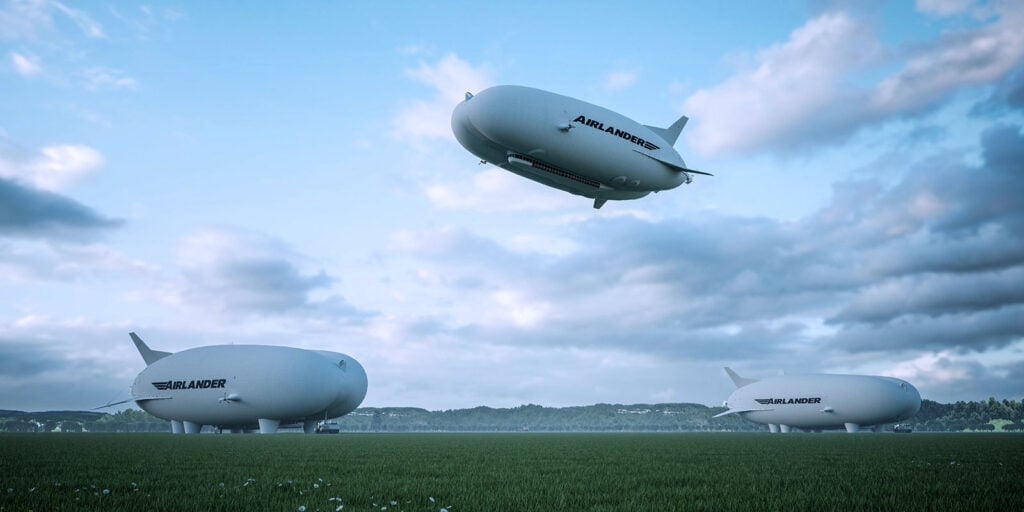
HAV describes Airlander as a potential “pseudo-satellite” platform, capable of remaining airborne for extended periods while carrying surveillance equipment and communications systems. Unlike conventional aircraft that may need to return to base after hours of operation, the Airlander 10 is designed for endurance of up to five days.
For Sentinel Hawk, the proposed payload capacity for mission equipment is reported at approximately three tonnes, with around 80 kW of electrical power available to operate onboard systems. These figures are proposed mission-system capabilities rather than demonstrated performance of an operational Sentinel Hawk.
The platform’s hybrid design combines helium buoyancy with aerodynamic lift generated by air flowing over its hull. Vectored thrust also assists with maneuvering, take-off and landing. HAV says the aircraft can operate from suitably large, relatively flat surfaces without conventional airport infrastructure, potentially allowing access to remote locations.
HAV’s planned Airlander 10 configurations are designed to accommodate up to 100 passengers, carry a 10-metric ton (11-ton) freight payload, or support other mission-specific layouts. The company’s published specifications include:
- Endurance: Up to five days airborne.
- Operating altitude: Up to 20,000 feet (approximately 6,100 meters).
- Ferry range: Up to 4,000 nautical miles (approximately 7,400 kilometers).
The ferry range refers to the distance the aircraft can fly between locations when relocating, rather than its typical operational range. HAV gives a figure of up to 2,000 nautical miles (3,700 kilometers) for certain long-range logistics, surveillance and communications applications. Actual performance will depend on configuration and operating conditions.
Who Are the Players?
WepTac A.G. is a U.S. defense systems integrator that describes itself as veteran-owned. It operates from Rochester, New York, and Largo, Florida, and focuses on integrating communications, command-and-control and intelligence systems, as well as providing training and ongoing operational support.
The company also operates the Osprey Accelerator, which identifies and evaluates emerging technologies for potential military applications. Its business model includes forming joint ventures around specific platforms and technologies, an approach it intends to apply to Sentinel Hawk. WepTac has reported more than $200 million in cumulative revenue over three years and has identified $1 billion in annual revenue as a growth target (company-reported figures).
HAV is a British aerospace company headquartered in Bedford, England. It develops hybrid aircraft that combine lighter-than-air buoyancy with aerodynamic lift and vectored thrust. Its Airlander program has potential applications in passenger transport, freight, communications, surveillance and defense.
Airlander’s History With the U.S. Military
HAV’s relationship with the U.S. military dates back more than a decade. Its earlier HAV 304 airship was developed for the U.S. Army’s Long Endurance Multi-Intelligence Vehicle (LEMV) program, with Northrop Grumman serving as prime contractor.
The aircraft made its first flight at Lakehurst, New Jersey, in August 2012, but the U.S. Army cancelled the LEMV program in 2013, and HAV subsequently bought the aircraft back and returned it to the United Kingdom.
After returning the prototype to UK soil, the company reworked the airship into the Airlander 10, which first flew in its revised form in 2016. The aircraft was damaged in 2017 after becoming detached from its mooring mast, and HAV later mothballed the prototype, but it has continued developing the Airlander concept and pursuing potential customers.
Dividing the Scope of Work
Under the proposed arrangement, HAV will contribute its aircraft platform, engineering expertise, and experience developing the Airlander. WepTac will focus on the military mission systems, including integrating command, communications and surveillance equipment, along with training, field support and maintenance.
WepTac will also lead HAV’s planned Series B investment round, intended to help finance production and support the delivery of missionised aircraft. While the companies have not publicly disclosed the round’s target size, WepTac co-founder and CEO Colby Fisher said U.S. warfighters need “persistent, affordable ISR capability they can field now,” adding that the partners are “moving fast.”
HAV CEO Tom Grundy said Airlander was designed for the type of persistent, long-endurance ISR missions sought by the U.S. defense community. He added that the partnership would give HAV access to WepTac’s integration expertise and the U.S. market.
The Path to Building Sentinel Hawk
HAV intends to certify Airlander 10 for civil operations before adapting the platform for different customers and missions, such as the Sentinel Hawk program, which will depend upon it. HAV has not yet delivered a production-standard Airlander 10 to a customer, and the prototype’s previous flights do not constitute certification of the planned production model.
HAV plans to manufacture the aircraft at a new production facility at Carcroft Common, near Doncaster in South Yorkshire, England, while retaining its design office in Bedford. Although the site has been identified for production, the Royal Aeronautical Society reported in February 2026 that construction had not yet begun. The joint venture announcement does not establish a delivery date for Sentinel Hawk.
Planned Operational Airships by 2029
HAV currently anticipates beginning test flights of its production aircraft before 2029, with the first customer aircraft entering service from 2029 onward. The schedule remains dependent on customer orders, certification, and production progress.
For Sentinel Hawk, the next major milestones will be securing the necessary investment, progressing Airlander 10 production and certification, and establishing a customer pathway for the military configuration. Until those steps advance, the project remains a proposed defense application rather than a confirmed U.S. military acquisition.
Sources and Further Reading:


Responses