
Hybrid Air Vehicles lands its first military reservation as undisclosed contractor takes three

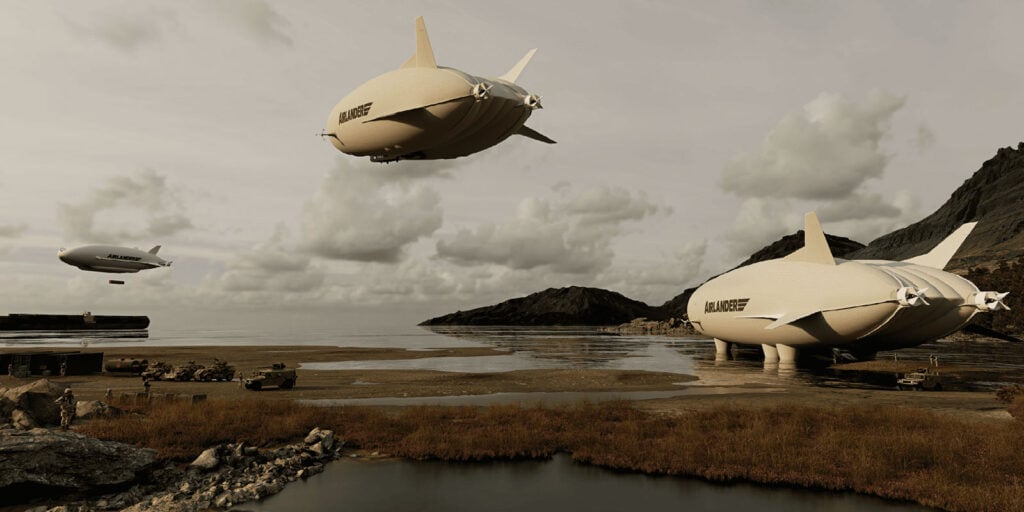
After more than a decade of being pitched primarily at airlines, polar tourism, and the green-aviation crowd, the Airlander 10 has its first defense-market reservation on the books. Hybrid Air Vehicles (HAV) announced on October 23 that an unnamed defense contractor has reserved three of the hybrid airships, the first Airlander 10 frames formally earmarked for military use.
It’s a meaningful step for a program that has spent years marketing the Airlander to defense customers alongside its civil applications. HAV estimates its potential military business at roughly $3.7 billion in identified opportunities, and says it expects more reservations to follow. For now, the deal is exactly that: a reservation, not a firm procurement contract. But it puts a defense customer on the order book alongside the roughly $2 billion in civil reservations HAV has already accumulated.
What the customer actually gets
The Airlander 10 is a hybrid airship, drawing lift from multiple sources rather than from buoyancy alone. Roughly 60 percent of its lift comes from helium contained in its envelope (the gas-filled outer hull), called aerostatic or static lift. The remainder is generated aerodynamically by the shape of the hull as it moves through the air, with vectored thrust (engines that can swivel to redirect their thrust) helping during low-speed operations and landing. Propulsion comes from four diesel engines driving ducted propellers, with vectored thrust used for takeoff, landing, and low-speed handling.
That combination is what makes the platform interesting to a defense buyer. Specifically:
Five-day endurance – HAV says the aircraft can stay aloft for up to five days without refueling. Long-endurance intelligence, surveillance, and reconnaissance (ISR) platforms like the MQ-9 Reaper measure their station times in tens of hours, so a single Airlander could provide continuous coverage that would currently require rotating multiple aircraft.
A 10-metric-ton payload – That’s enough to carry a serious radar, multispectral sensor suites, communications relays, or a meaningful number of small drones in any combination. HAV says the aircraft can also be used to deploy and recover drone swarms.
Operations from almost any relatively level surface, including water – No runway or prepared apron is required. For expeditionary or maritime work, that’s a genuinely unusual capability, and one that few fixed-wing aircraft can match without more supporting infrastructure.
Lower acoustic and infrared signatures than many conventional aircraft – HAV argues that its design is harder to detect than comparable fixed-wing platforms, because it does not use gas-turbine engines and flies relatively slowly. That matters for both detectability and survivability in surveillance work.
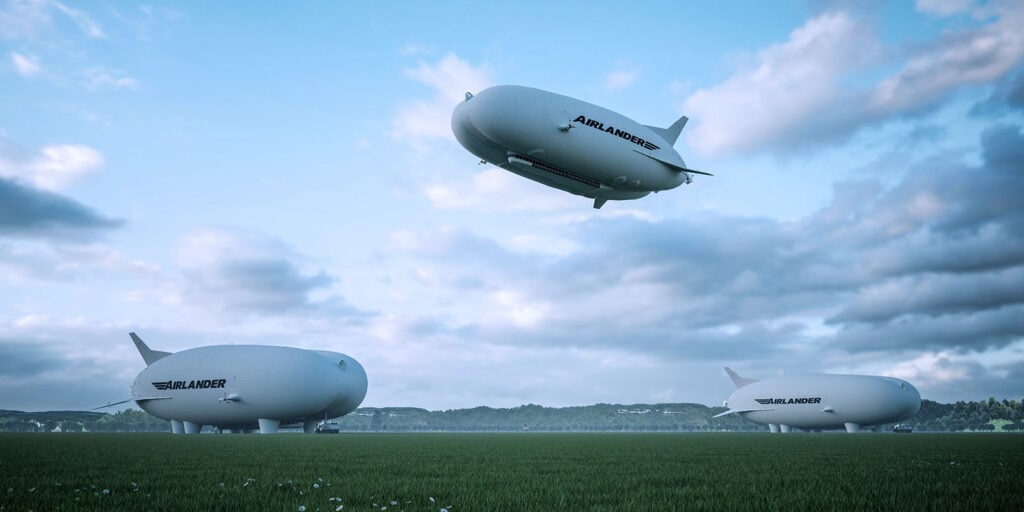
At roughly 320 ft (98 m) long, the planned production aircraft would be among the largest aircraft in the world. Taken together, the endurance, payload, operational area flexibility, and signature profile add up to a capability set that has no clear equivalent in current military aviation.
Who is the customer?
HAV is not saying. The company has only described the buyer as an “innovative defence contractor” planning to deliver Airlander capability to its own customers.
There’s been informed speculation about who it might be. HAV signed a memorandum of understanding (MOU) with BAE Systems in September 2023 to explore military applications for Airlander, which makes BAE an obvious candidate, though HAV has not said whether the new reservation flows from that MOU. The company has also been working with the US Naval Postgraduate School under a Cooperative Research and Development Agreement looking at the Airlander as a logistics connector for the US Navy and Marine Corps, and more broadly has been pushing into the US market. The customer could plausibly be British, American, or perhaps from somewhere else entirely.
The roles HAV is targeting
HAV identifies four mission areas where it sees the Airlander fitting into modern defense work:
Elevated sensing for missile defense. Lifting a heavy radar to altitude and keeping it there for days, rather than hours, lets a sensor network see farther and surveil for longer. This is conceptually similar to what high-altitude platform stations and certain tethered aerostats are trying to do, but with more payload and greater freedom of movement.
ISR and C4ISR more broadly. Command, control, communications, computers, intelligence, surveillance, and reconnaissance (C4ISR). The Airlander can carry mixed sensor packages (electro-optical, infrared, signals intelligence) and act as an airborne command and communications hub for other assets. The cabin is large enough to support onboard data processing rather than just collection and downlink.
Drone and anti-drone operations. The Airlander has the volume and the endurance to function as an airborne mothership for unmanned systems, launching, recovering, and refueling drones from altitude, and the sensor capacity to track hostile drones across a wide area. No doubt an Airlander could also accommodate anti-drone weapon systems, though such uses are not confirmed.
Maritime patrol and anti-submarine warfare. Wide-area ocean surveillance, sonobuoy distribution, and acting as a communications node for anti-submarine assets are all jobs that benefit from long flight endurance and low operating cost per hour.
The Airlander 10 is HAV’s immediate program, with the larger Airlander 50 and Airlander 200 versions planned for the future, with payload capacities of 50 and 200 metric tons respectively.
Where the program stands
HAV began survey and preparatory work at its planned production site at Carcroft Common in Doncaster, South Yorkshire, in December 2024, after the first tranche of a £7 million ($9 million) regional loan was released. Once built, the 50-hectare (124-acre) facility is intended to have capacity for up to 24 aircraft per year. HAV’s current investor materials say it anticipates test flying near-production aircraft before 2029, with the first customer units expected to enter service from 2029 onward. The Airlander 10 prototype was originally the HAV 304, built in the US for the Army’s canceled Long Endurance Multi-intelligence Vehicle (LEMV) program. HAV bought it back from the Army after the program ended, rebuilt it in the UK, and flew it as the Airlander 10 from 2016 until a 2017 mooring incident at Cardington left it unrepairable.
HAV’s current timeline puts the first production aircraft in service from 2029 onward. The three military reservations sit alongside the civil orders already in the queue.
Why this matters for the wider airship sector
The Airlander 10 reservation is a meaningful signal even if modest. After decades of defense interest in airships producing studies, prototypes, and the occasional canceled program with few actual production commitments, a defense buyer has now pointed at a specific production aircraft and reserved a place in line. The customer is undisclosed, the contract is not firm, and the deliveries are years away, but the direction is promising.
This matters for HAV directly, since defense customers represent both a substantial serviceable market and a different kind of reference than a tourism operator or a regional airline. It matters for the broader lighter-than-air industry because it suggests defense procurement may be more willing to commit to LTA platforms rather than treating them as mere research curiosities. LTA Research, Sceye, Kelluu, and the various tethered aerostat operators all stand to benefit if more defense buyers see these platforms as viable options.
Whether the Airlander 10 can deliver on what HAV is promising remains an open question. The reservation is a vote of confidence. The verdict will come when the production aircraft begin flying.
Sources and Further Reading:
- BBC News: ‘Airship’ firm secures first military reservations
- Military Embedded Systems: Hybrid airship reserved for first military applications
- Aerospace Global News: Hybrid Air Vehicles lands first military deal for Airlander 10
- Hybrid Air Vehicles: First military aircraft reservation for Airlander
- Hybrid Air Vehicles investor overview
- Janes: Hybrid Air Vehicles reports first undisclosed military client
- Flight Global: HAV locks in ‘innovative defence contractor’ for three Airlander 10s
- Aerospace Testing International: Preparatory work starts at Airlander factory site in Doncaster

Responses