
AIRSHIP Act Aims to Elevate NASA Research


Update, March 5, 2026: The AIRSHIP Act has continued to move on Capitol Hill since this article was first published. On February 4, the House Committee on Science, Space, and Technology adopted an amendment from Rep. Sykes folding the bill’s text into H.R. 7273, the NASA Reauthorization Act of 2026, which the committee then approved 37-0. On March 4, the Senate Commerce, Science, and Transportation Committee unanimously advanced S. 933, the NASA Transition Authorization Act of 2025, as amended into its NASA Authorization Act of 2026 package. The fate of the airship language now depends on what survives the broader House and Senate authorization process.
Original article continues below.
Bipartisan legislation introduced by two Ohio lawmakers would expand NASA’s research into airships, examining their potential in areas that include sustainable cargo transport uses, disaster response, and humanitarian aid.
The congressional push is being made to clarify federal inclusion of airships into NASA-based research and development, legislation that represents one of the clearest recent efforts to explicitly include airships within NASA’s aeronautics research mission.
The U.S. space agency indirectly supports airship-related research through individual projects, technology studies, and university grants, but the aircraft are not explicitly identified within NASA’s core aeronautics research authorities. This change could increase the visibility of lighter-than-air technologies by making it easier to support related research programs through competitive grants and partnerships.
AIRSHIP Act Sets Lofty Goals and Signals Congressional Intent
The AIRSHIP Act was introduced as H.R. 6898 in the 119th Congress, and it offers a promise to make airships an explicit part of NASA’s aeronautics research agenda. The bill would solidify a Congressional view that modern dirigibles could play important roles in everything from sustainable cargo transportation and disaster response to humanitarian relief.
According to the lawmakers involved, the objective of the act is to set policy and signal congressional intent. The long-range vision of the proposal would make it easier for NASA to award competitive grants to universities, private companies, and nonprofit organizations, and approval of the bill would also clear the path for government laboratories to conduct research on modern airship technologies.
Why Ohio Representatives Are Backing The Bill
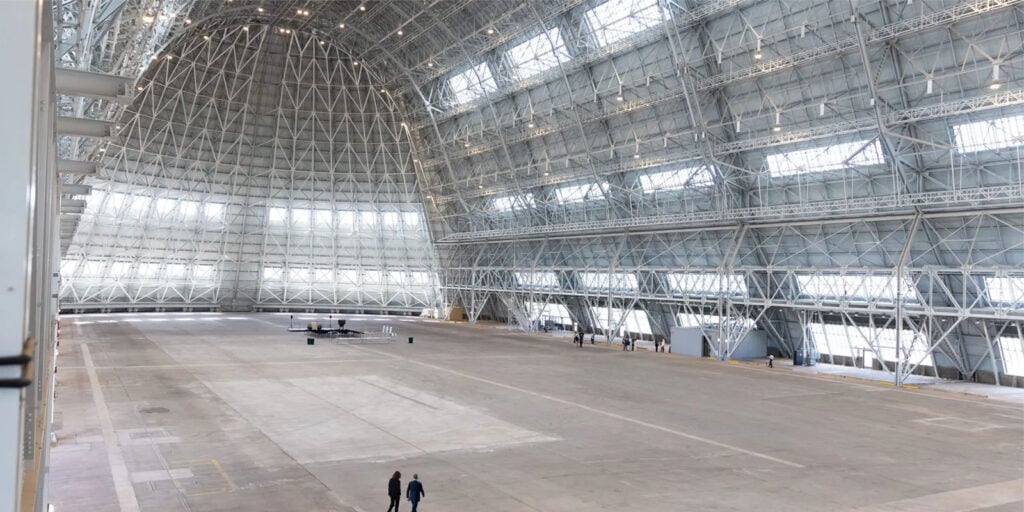
The Ohio state backing is not a coincidence. The Representatives petitioning the bill are Dave Joyce and Emilia Sykes. Joyce’s District includes NASA’s Glenn Research Center near Cleveland, one of the agency’s main aeronautics centers. Sykes’ district includes Akron, the home of Goodyear’s Wingfoot Lake Airship base, and the cavernous Goodyear Airdock.
The historic 1920s-era hangar was used by the U.S. Navy for the construction and maintenance of the rigid airships USS Akron and USS Macon, and has been repurposed for the next generation of airship construction. At present, the hangar is leased to LTA Research (backed by Google co-founder Sergey Brin). They are using the massive facility to research, develop, and test airships with hybrid-electric propulsion.
An Investment in the Future
“Airships are not just part of our history; they are part of our future,” Sykes said in a statement announcing the bill’s reintroduction, framing it as a way to support local leadership in dirigible technology and encourage applications in disaster response and humanitarian delivery.
Wording in the bill identifies the lawmakers’ belief that airships are a viable platform for reaching remote or infrastructure-poor areas, meeting difficult-to-achieve surveillance needs, and that the technology supports goals of environmentally friendly aviation.
Joyce leaned even harder on the state’s broader aviation-pioneering perspective. “From the Wright Brothers to the NASA Glenn Research Center, Ohio has a rich history of advancing aviation technology,” he said, arguing that federal R&D should cover “the full spectrum of aircraft, including airships, which have unique capabilities that allow them to service remote areas or those affected by disaster.”
The Congressional movement undertaken by Joyce and Sykes has strong advocates in industry and collegiate fronts, too, having been formally endorsed by The Goodyear Tire & Rubber Company and by the University of Akron. Dr. Craig Menzemer, dean of UA’s College of Engineering and Polymer Science, said in a statement that the university looked forward to opportunities for faculty and students “to continue leading research and technology initiatives that advance innovations in the airship industry.”
How The AIRSHIP Bill Impacts NASA Programs
The AIRSHIP Act is an acronym, standing for Airship Improvement Research for Safety and Humanitarian Innovation Projects Act, and true to that wording it seeks to clarify the statutory definition of NASA’s aeronautics research authority to explicitly include airships.
While NASA already supports airship-related research through broader aeronautics and atmospheric science initiatives, dirigibles are not clearly identified within the umbrella of aircraft. Current NASA areas that include lighter-than-air vehicle technology are the High-Altitude Platform Systems (HAPS), atmospheric science, and planetary exploration divisions.
Despite the airship-friendly framing, the AIRSHIP Act is fairly modest in scope. It would not spin up a new federal program from scratch, nor would it allow the direct appropriation of funding. Instead, the intent of the bill is to amend Title 51 of the U.S. Code, formally placing airships under the umbrella of NASA’s current aeronautics research authorities.
Legislation Would Formally Include Airships in NASA Aeronautics
The proposed changes would give the U.S. space agency authority to set up a competitive grant program open to teams from universities, industry, and government working on dirigible technology. In practical terms, the AIRSHIP Act would authorize NASA to pursue research initiatives focused on the safety, noise, and environmental impact of airships. There is also a provision to study what the legislation describes as resiliency; essentially, the ability of aircraft to keep operating for extended periods in difficult or degraded conditions.
Explaining The Interest of NASA
Researchers have long identified several advantages modern dirigibles could offer over conventional aircraft for certain missions, including:
- Extremely low fuel consumption with large payloads.
- Ability to operate without roads or prepared runways, making them well suited to difficult terrain.
- Heavy cargo delivery to remote locations.
- Quiet, extensive periods of surveillance and communications.
These characteristics align closely with NASA’s broader goals of improving transportation efficiency while enabling new scientific missions. In the passing of the act, Congress would be sending the message that airships offer the potential to enable sustainable air cargo, disaster response, and humanitarian aid, particularly in places that conventional fixed-wing aircraft and helicopters struggle to reach.
Where the Bill Stands
As of early January, bill H.R. 6898 had been referred to the House Committee on Science, Space, and Technology, where the standalone bill awaits action. An earlier version of the legislation was introduced by Sykes in the previous Congress and approved by the same committee, but did not receive a vote on the House floor before the session ended.
Since authorization bills like this one do not appropriate funding on their own, even if the AIRSHIP Act is passed, NASA airship grants would still depend on appropriators choosing to fund the work in future budgets. NASA authorization legislation has also had a difficult run in recent years. There was NASA authorization language passed in 2022 as part of the broader CHIPS and Science Act, but in 2024 the effort died in the Senate.
The Future of NASA Airship Research
Putting the word “airship” into NASA’s statutory aeronautics designations pairs the lighter-than-air craft alongside heavier-than-air craft, potentially making it easier for the agency to fund university and airship industry work without having to argue that the topic falls within its mandate. It would also potentially give Akron, with its historic airship hangar and a university actively trying to build out aerospace research capacity, a meaningful boost in support.
Whether any of that materializes depends on the airship language surviving the broader authorization process and on appropriators following through. But for the first time in a long time, modern airships have a small, bipartisan beachhead in NASA policy language, and a pair of Ohio lawmakers who seem inclined to keep pushing.
Sources and Further Reading:
- Ohio lawmakers reintroduce bill to advance modern airship research, News5Cleveland
- Rep. Sykes Reintroduces Bipartisan AIRSHIP Act press release, U.S. House
- H.R. 6898 – AIRSHIP Act, 119th Congress, Congress.gov
- Full Committee Markup of the NASA Reauthorization Act of 2026, House Science Committee
- Commerce Committee Advances NASA Reauthorization Act and Weather Act, U.S. Senate Commerce Committee




Responses