
Flying Whales Charts Hydrogen Path for LCA60T as France’s Defense Procurement Agency Backs the Program

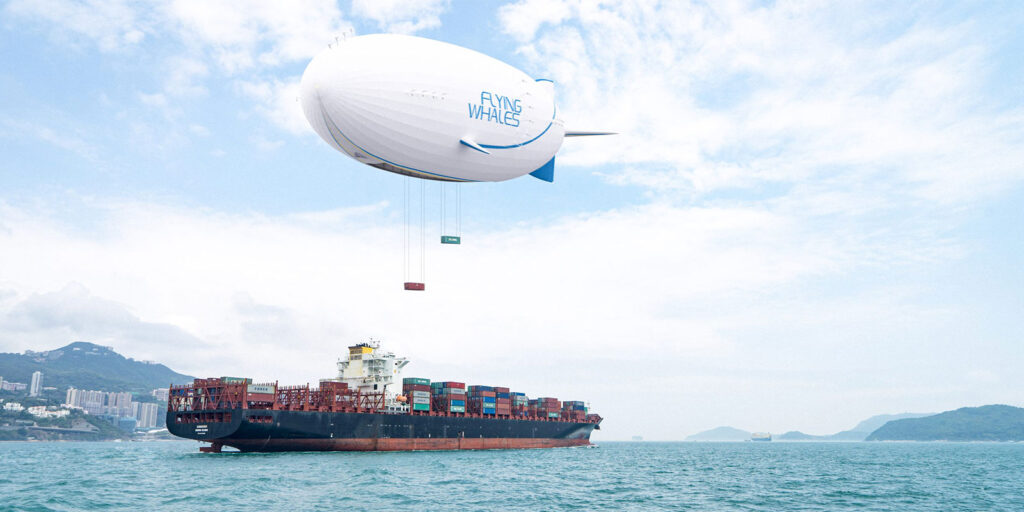
One of the most ambitious cargo airship programs in development has a clearer propulsion roadmap. France’s Flying Whales says its 60-metric-ton LCA60T is planned to enter service with a hybrid-electric powertrain. However, a fully electric system based on hydrogen fuel cells is targeted to follow by 2030. The French defense procurement agency, the DGA, is also offering access to aerospace test facilities for parts of the program.
Speaking at the Aerospace Test and Development Show in Toulouse, hydrogen propulsion program manager Neji Khairi outlined the roadmap and said hydrogen has been part of the company’s thinking for years, even if it will not be employed on the airship at the outset.
A quick refresher on the LCA60T
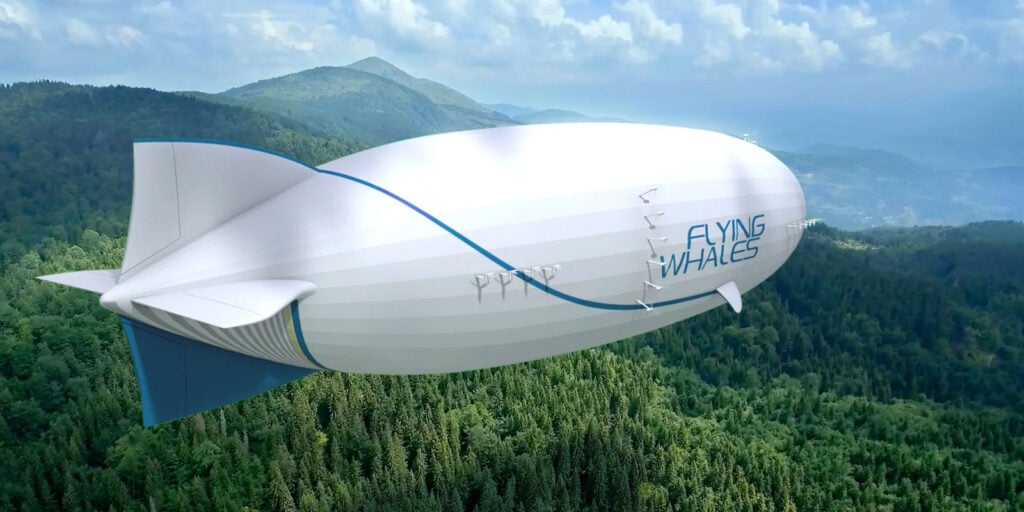
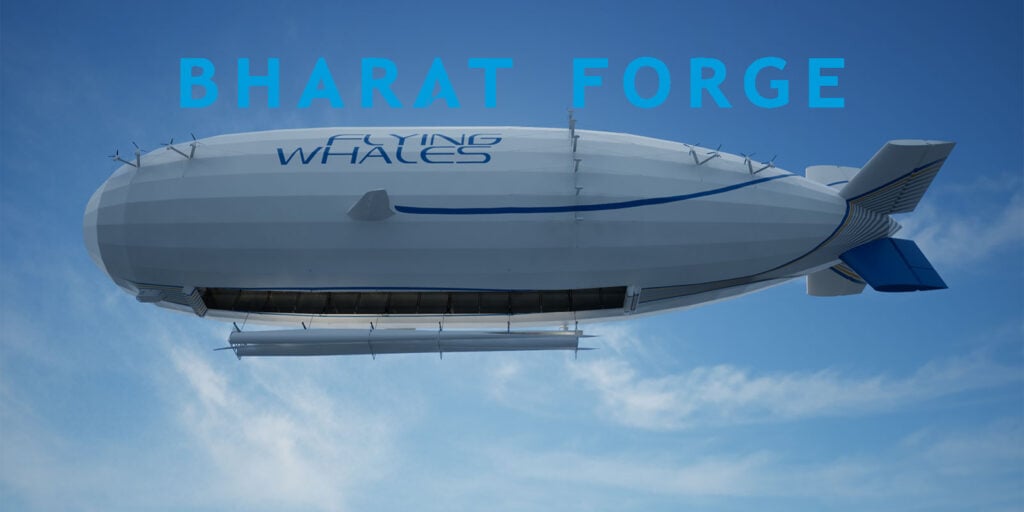
Founded in 2012, Flying Whales has spent more than a decade developing the LCA60T, the designation of which stands for Large Capacity Airship and a 60-metric-ton payload. The aircraft is a rigid airship measuring roughly 656 ft (200 m) long and 164 ft (50 m) in diameter. A rigid airship is one whose shape is held by an internal structural framework rather than by the pressure of the lifting gas itself, the same basic class as the Zeppelins of the early 20th century. Lift comes from 14 unpressurized helium cells housed inside that framework, and propulsion in the initial configuration is handled by a 4 MW (5,360 hp) hybrid-electric system powering a distributed array of propellers driven by electric motors.
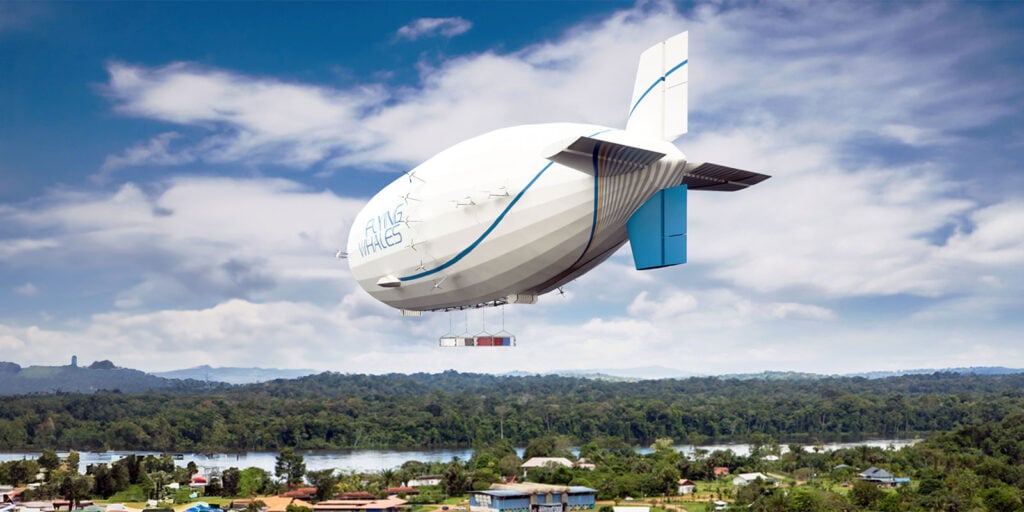
A major purpose for the LCA60T is serving the role of a hovering aircraft to lift cargo that is too heavy or bulky for current helicopters. Rather than landing to load and unload, the LCA60T is intended to pick up and drop off cargo while holding station, using an internal winch system and a hold large enough to accommodate awkward freight that current aircraft are unable to carry effectively. Wind turbine blades, harvested timber, modular building components, and humanitarian payloads are all on the company’s pitch deck. The trade-off, of course, is that station-keeping a 656 ft (200 m) aircraft against the wind is a serious engineering problem in its own right, and one that the LCA60T’s distributed arrangement of 32 electric thrusters is designed to solve. A future hydrogen fuel cell system would serve as a central power source for that same arrangement.
The hydrogen plan
Mentioning ‘hydrogen’ and ‘airship’ together might raise a few eyebrows, but what Flying Whales is proposing is a fuel change, not a lift change. Hydrogen will be for fuel cells while helium continues to do the lifting. The initial 4 MW (5,360 hp) hybrid-electric powertrain is just a starting point for the platform’s propulsion system. According to Khairi, Flying Whales has been studying hydrogen propulsion for around five years and is targeting 2030 to begin putting hydrogen fuel cells to more significant use in the program. The development effort is being led by the company’s Innovation Department.
Hydrogen fuel cells are a particularly natural fit for an airship of this scale. They produce electricity from hydrogen with water as the only direct onboard emission. Per unit of energy delivered, a hydrogen fuel cell system consumes far less fuel mass than a combustion turbogenerator, and the water byproduct can be more easily captured onboard rather than lost as exhaust. Both characteristics reduce the loss of fuel mass that combustion-powered airships have historically needed to compensate for. This makes buoyancy management related to fuel consumption much simpler.
Defense backing and dual-use framing
Flying Whales has also secured visible backing from the Direction générale de l’armement (DGA). The DGA recently toured the company’s facilities, including its model production center, design offices, and full-scale cockpit and load-handling simulators, and has agreed to make its aerospace test infrastructure available to the program through DGA Techniques aérospatiales.
In a statement issued by the DGA about the visit, agency chief Emmanuel Chiva framed the support in terms of the project’s dual-use potential. “Their dual innovation meets both civil and military needs, while reducing the environmental and economic costs of air cargo transport – the DGA supports them, in particular by making its test facilities available to DGA Techniques.”
Flying Whales has pitched the LCA60T as having direct relevance to France’s domestic economy. The company makes the case that its airship could give the country sustainable access to its own forest resources, reducing the economic deficit caused by heavy reliance on imported wood. The same hover-and-load capability that suits remote forestry or wind-farm construction also describes a useful tool for moving outsized military cargo into places without prepared runways or ports.
Where this leaves the program
Flying Whales is still working toward a prototype, and the hydrogen propulsion architecture is a parallel development track rather than a day-one feature of the aircraft. The recent disclosures lay out the program’s near-term picture. The LCA60T will enter service with the 4 MW (5,360 hp) hybrid-electric powertrain, hydrogen fuel cells are targeted to follow around 2030, and the French DGA’s aerospace test facilities are now part of the development effort.
Sources and Further Reading:
- Thomasnet: Blimp-Like Airship Takes on the Future of Eco-Friendly Transport (Video)
- Project Cargo Journal: Hydrogen power mooted by Flying Whales for its 60-tonne airship
- Aerospace Testing International: Flying Whales outlines hydrogen future for cargo airship
- Flying Whales: The LCA60T
- Flying Whales: Q&A / FAQ
- Flying Whales: LCA60T batteries
- Honeywell press release: 1-Megawatt Generator to Power Flying Whales’ LCA60T Aircraft
- Air Liquide: Flying Whales, a new take on the airship


Responses