
Buoyant Aero Pitches Unmanned Blimps as a Billboard Alternative

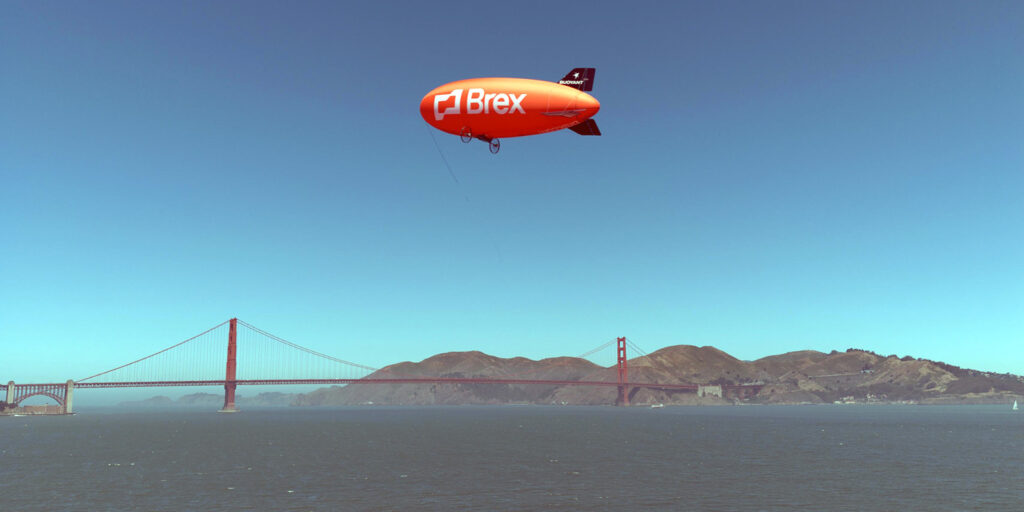
Outdoor advertising availability in San Francisco is running low, but one West Coast startup has an innovative solution: using custom designed blimps to put billboard-sized advertising aloft.
Travel in any major city in the USA, and you are sure to see one thing: Billboards. Strategically located billboards are a proven, age-old way to advertise, but lately, a few challenges have emerged—the biggest being cost.
San Francisco is one example of a city where prices for traditional billboard advertising have gone sky-high. In the Bay Area, where that squeeze is sharpest, advertising space is booked out years in advance.
Enter Buoyant Aero: A Company with a Novel Solution.
Buoyant Aero, Inc. builds small uncrewed blimps, covers them in their clients’ custom artwork, and flies them over high traffic areas such as beaches, convention centers, and busy city streets, offering a modern take on a decades old way of advertising. What the blimp company is betting on is that when advertisers can’t find room on a billboard—or don’t want to pay inflated prices—they will be eager to send their message skyward instead.
So far, the business model appears to be gaining some influential customers. Over the 2025 July 4th weekend, Amazon Prime Video and MGM Studios flew a blimp for the film Heads of State along the Los Angeles coastline. The targeted flight path was from Malibu to Redondo Beach during a three day period, which Buoyant says produced more than 762,500+ impressions.
Another blimp flew over a nursing conference in New Orleans for the healthcare startup Adni. Three illuminated blimps also flew at Burning Man in 2025 carrying no advertising, but still serving as attention getters.
How it Works
Customers select an aircraft, customize the wrap, and schedule flights with Buoyant’s crews. A separate flight simulator tool checks whether the desired address sits in accessible airspace. Buoyant’s company literature tells customers to allow roughly 90 days for FAA clearances, with expedited options sometimes available. From there, Buoyant Aero handles the inflation, operations, and breakdown.
A graphic artist at Buoyant Aero handles the logo upload and 3D preview, and, once approved, there is a two- to three-week timeline for printing an envelope. Company literature also notes that wraps can be reused, with no clear estimate for the lifespan of each wrap. The company publishes no rate cards, instead describing cost as “driven by helium prices, crew, hardware and printing.”
Why Billboards Are Hard to Buy in San Francisco
When it comes to rising outdoor advertising costs, San Francisco is the extreme. It has limited outdoor advertising inventory to begin with, and four main players control that inventory: Outfront, Clear Channel, Intersection, and JCDecaux. Between them, they leave very few outdoor options available.
Compounding the market constraints further is the highly concentrated advertising area. With a city of roughly 7 mi by 7 mi (11 km by 11 km), a dense population is contained in a small space, explaining why the city and the main highway corridor of US-101 have become one of the most contested stretches of advertising in the continental United States.
Along the expressway linking the city, airport, and Silicon Valley are 170 billboards, according to the San Francisco Standard, and roughly 20 of them are digital. Kasper Koczab, who buys billboards for the corporate card company Brex, is one example of an advertiser facing steep cost increases. Koczab told Forbes that a Bay Area board he leased monthly for around $60,000 came back at $120,000 with a two-year commitment.
Most boards north of the city are locked up by incumbents holding renewal rights, so very few advertising options pop up, and advertisers are left scrambling for what remains. Koczab’s minimum estimate for a serious 4-6 week campaign in the city is a staggering $300,000.
Getting Airborne with a Message
Unlike the billboard market, the aerial advertising space has few established competitors and no equivalent system of long-term leases and renewal rights. And, unlike a billboard fixed to a single stretch of the 101, a small blimp is mobile. The airborne advertising can work the coastline one day, and move to key spots like convention centers the next.
These modern blimps utilize smart tech, too: each aircraft can carry a 4K camera for aerial livestreaming. Operating speeds are kept to under 10 mph (16 km/h), with flight durations up to 8 hours. The company is working toward a 24-hour endurance target, earmarking the longer flights for sometime in 2027.
Looking Up – Why Sky Advertising is Appealing
The rocketing cost of prime billboard space is a big part of the argument for using airborne advertising, but it isn’t the only reason. Billboards offer 24/7 exposure, but they can’t show up above a specific venue on a specific morning, wherever the venue happens to be, sporting the exact audience-targeted message an advertiser wants.
Buoyant Aero’s compact, uncrewed blimps broadcast customers’ artwork across the hull, and put them exactly where the client has chosen. It is a novel business idea, and the timing for launching its advertising blimps in places like San Francisco appears to be fortuitous. Interestingly, though, advertising came as an afterthought for the unmanned airship company.
Switching From Cargo to Advertising
Buoyant Aero’s original business plan focused on an entirely different area: transport. Ben Claman and Joseph Figura founded the company in 2020, launching through Y Combinator’s Summer 2021 batch. The initial pitch was rural parcel delivery: moving loads from a regional hub out to small communities, depot to depot, at a far cheaper cost than chartering a light plane. It was a new idea, but one based on a long history of airship flight, with 2025 marking the 100 year anniversary of the Goodyear blimps.
“People were building blimps before computers, people were building blimps before they really understood aerodynamics, so we have some advantage there on just the length of time that people have been building airships,” Claman is quoted as saying. “There’s a lot of data out there. It’s not like airship development has stopped. People have been developing airships continuously, basically, over 100 years.”
The company’s original aircraft was a battery-electric hybrid, with helium supplying roughly 70 percent of the lift and tilt-rotors handling the rest. Buoyant Aero has flown four transport-based prototypes, including a 20 ft (6 m) twin-hull demonstrator that picked up and dropped small payloads. Plans included a 60 ft (18 m) version capable of carrying 650 lb (295 kg), although further development and certification on that business model now have a longer timeline.
For the moment, delivery airships remain in the hangar, as Buoyant Aero sets its sights on the advertising game. At present, Buoyant Aero’s most common advertising model runs at about 35 ft (11 m) in length, roughly the size of a school bus.
The Limits of the Model
Buoyant Aero says that the smaller aircraft they developed for advertising can operate within the FAA’s small-UAS regulatory framework, avoiding the conventional certification path required for larger aircraft.
The framework of Part 107 covers small, unmanned aircraft, and is intended for aircraft under the control of a certificated remote pilot, with a visual line of sight. The weight restriction for this class is set at a maximum of 55 lb (25 kg) on takeoff.
Helium does not help an operator duck those weight restrictions, though. Asked in 2017 whether positive buoyancy offsets takeoff weight, the FAA’s chief counsel’s office replied that what matters is total mass, regardless of the method used to create lift.
Part 107’s rules for operations over people have evolved in recent years, restricting the ability to fly over people depending on the level of risk that a small UAS operation presents to those on the ground.
As of April, 2021, the FAA final rule amends part 107, permitting routine operations of small unmanned aircraft over people, moving vehicles, and at night only under certain conditions. It also changes the recurrent training framework, expands the list of persons who may request the presentation of a remote pilot certificate, and makes other minor changes.
Buoyant Aero states that it holds an FAA waiver for certain operations over people and moving vehicles, but the regulations still prohibit sustained hovering or loitering over nonparticipants, and generally require established routes to minimize such overflight.
Operations over open-air assemblies are typically barred unless certain conditions are met, and provided that Buoyant Aero coordinates in advance with the event’s security planner (or venue representative).
Brex opens a second door
An additional route to a Buoyant Aero blimp ad could run through a credit card, thanks to Brex.
The corporate card and expense management company was founded in 2017, and it’s known for issuing cards to venture-backed startups conventional banks would not underwrite. Capital One completed its acquisition in April 2026. In April 2024, Brex added advertising to its rewards menu under the name Billboard Rewards, letting cardholders spend points on ad space rather than flights or gift cards. Points convert at 100 to $1, with minimums of 300,000 points for a campaign built around an industry event and 5,000,000 for a bespoke buy where Brex plans and books it.
No blimp option appears on that menu so far; Instead, what exists is an informal arrangement between the two companies that began in part with Brex’s own ad campaign with Buoyant Aero. Brex has a media desk that can plan and book campaigns for its cardholders, and those with existing points balances have a budget that does not require approving a new line item. Clients that come through Buoyant’s own intake form without a Brex relationship are in turn given the introduction.
Long Term Planning
Buoyant Aero appears to have high hopes for its new advertising focus, but Claman does not expect the format to scale forever. Claman expects each metropolitan market to eventually reach a saturation point, limiting how many blimps can operate. The company’s longer-term opportunity, he suggests, may therefore depend on what else the airships can carry or do.
Connectivity and weather sensing play a role, too, as does the 8-hour maximum time aloft. The company’s goal to have a blimp capable of 24 hours aloft within a year may open up new options, though.
Sources and Further Reading:
- Buoyant Aero company site
- FAA Certificate of Waiver 107W-2026-00686, issued to Buoyant Aero, Inc.
- Y Combinator company profile: Buoyant Aero
- TechCrunch: YC grad Buoyant wants to solve middle-mile delivery with cargo airships
- Lyncean Group, Modern Airships: Buoyant Aero
- Forbes: ‘How Can I Get One’—Brex Points Suddenly Buy Blimps Not Billboards
- SF Planning: General Advertising Sign Program
- Brex support: Billboard rewards
- Brex product announcement: New rewards redemption options (April 10, 2024)
- Capital One: Capital One Completes Acquisition of Brex
- FAA: Operations Over People rule
- FAA legal interpretation on sUAS takeoff weight and positive buoyancy


Responses